Three days is the right length for a first visit to Amsterdam. It is enough time for the two big museums, the medieval centre, the Jewish Cultural Quarter, the Jordaan and the north bank of the IJ, without having to queue anywhere. Each day covers one part of the city, so you walk rather than criss-cross it: Museumplein and the canal ring on day 1, the old centre and the Plantage on day 2, and the Jordaan, the Spaarndammerbuurt and Amsterdam-Noord on day 3. Most days add up to 5–7 km on foot, all of it flat, with a tram or a free ferry where the distances get longer.
The order of the days matters more than in most cities, because several stops close on particular weekdays. The Portuguese Synagogue is closed on Saturdays, so day 2 has to fall between Monday and Friday. The Jordaan's big markets run on Saturday, and Museum Het Schip is closed on Mondays, so day 3 works best on a Saturday. Thursday, Friday, Saturday fits everything. If you have only one day, follow our One Day in Amsterdam plan instead.
Book these before you go. All of them use timed tickets, and the first two cannot be bought at the door.
- Anne Frank House (day 3 evening): tickets are sold only online, at annefrank.org. Every Tuesday at 10:00 (Amsterdam time) the museum releases the tickets for the date six weeks later. Aim for a slot between 20:00 and 21:00. Adults €16.50, ages 10–17 €7, not suitable for children under 10.
- Van Gogh Museum (day 1): timed tickets at vangoghmuseum.nl. Adults €25 in 2026; under-18s go free but still need a ticket.
- Rijksmuseum (day 1): timed tickets at rijksmuseum.nl. Pick the 09:00 start. Adults €25, under-18s free with a ticket.
- Rembrandthuis (day 2): a time slot is recommended rather than required, and the queue moves faster with one.
Day 1: Museumplein and the canal ring
Day 1 stays in the south of the centre. You see two of the world's great collections of Dutch painting, walk through the city's main park and finish on the water.
09:00 — Rijksmuseum: the Night Watch before the crowds
The Rijksmuseum opens at 09:00 every day of the year and closes at 17:00. It is busiest between about 11:00 and 15:00, so go straight in at opening time and up to the second floor. The Gallery of Honour there leads to Rembrandt's Night Watch, past Vermeer's Milkmaid, Frans Hals and the big Golden Age group portraits.
The Night Watch is on view, but inside a glass chamber. Since July 2019 conservators have worked on it in public as part of Operation Night Watch, and varnish removal began at the end of 2024. Treated sections look matt for now. Allow two to two and a half hours, then leave through the public passage under the middle of the building. Its centre lane is a cycle path, so keep to the sides.
11:30 — Vondelpark
Walk south-west along the Museumplein to the Van Baerlestraat end of the Vondelpark. The park opened in 1865 as the "Nieuwe Park" and was later named after the poet Joost van den Vondel. It covers 47 ha and was laid out by J.D. and L.P. Zocher, reaching its present size in 1877. The path along the ponds to the Overtoom end is about 1.5 km. This is the place to have a picnic lunch, and the place to practise cycling before you try the canal belt on a rented bike.
 The Grote Vijver, the large pond in the middle of the Vondelpark. Image: Alf van Beem, Public domain, via Wikimedia Commons.
If it is a Wednesday: the Royal Concertgebouw, on the far side of the Museumplein, gives a free 30-minute lunchtime concert at 12:30 most Wednesdays, every month except July and August. The concerts are free, but you need a ticket: they go on sale online at 10:00 on the Thursday of the week before, with a maximum of two per person, and they often run out.
 The Concertgebouw, opened in 1888, seen from the Museumplein. Image: Diego Delso, CC BY-SA 4.0, via Wikimedia Commons.
13:30 — Van Gogh Museum
Back on the Museumplein, the Van Gogh Museum holds the largest collection of Van Gogh's work anywhere. The permanent collection takes about 75 minutes. Until 10 January 2027 the museum is also showing Whistler. Dandy and Disruptor, the first Whistler retrospective in the Netherlands, so allow about two hours if you want both. The museum opens daily from 09:00 and stays open until 21:00 on Fridays. Buy tickets only from its own site or the resellers it lists, because fake tickets are sold online.
On a Friday: book an evening slot here instead and move the canal cruise into the afternoon. Alternative: the Stedelijk Museum next door is open daily 10:00–18:00 (adults €22.50, under-19s free) and is showing a Yayoi Kusama retrospective until 17 January 2027.
 The Van Gogh Museum at dusk, with the exhibition wing on the left. Image: C messier, CC BY-SA 4.0, via Wikimedia Commons.
16:00 — A canal cruise from Stadhouderskade
The cruise boats along Stadhouderskade, across the road from the Rijksmuseum, are the easiest way to see the 17th-century canal ring, which UNESCO inscribed as a World Heritage Site in 2010. Stromma (pier at Stadhouderskade 520) and Blue Boat Company both run 60–75-minute cruises from here. In autumn 2026 a standard cruise cost about €15–28 depending on the operator, the boat and whether you book online, plus a city levy of about €2.70 per passenger that some operators add at checkout. Large glass-roofed boats run in any weather with an audio commentary. Small open boats carry fewer people and a live guide, and they are better on a dry day. See our canal cruise guide for the options.
17:30 — The canal belt at dusk
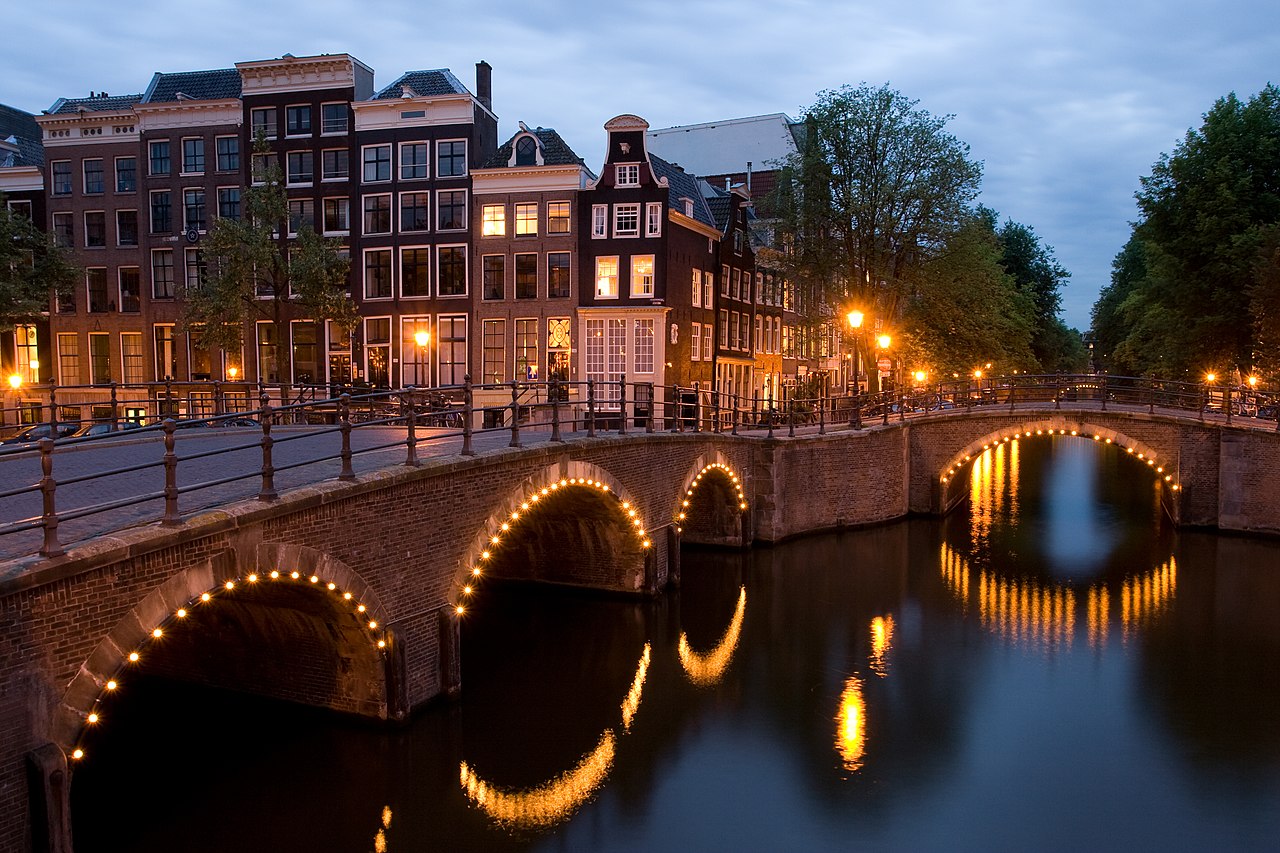
From the pier, walk north up Nieuwe Spiegelstraat, the antiques street, into the canal ring. Turn right along the Keizersgracht to the point where it crosses the Reguliersgracht. From the bridge there you look down the Reguliersgracht, a narrow canal lined with arched bridges. Find dinner anywhere around the Utrechtsestraat or back towards Leidseplein, rather than on Damrak.
Day 2: The medieval centre and the Jewish Cultural Quarter
Day 2 is a walk of about 3–4 km from Dam Square through the oldest part of the city to the Plantage and back along the Amstel. Do it Monday to Friday. On Saturday the Portuguese Synagogue is closed, and on Sunday the Waterlooplein market is closed and the Oude Kerk does not open until 13:00.
 Damrak at blue hour, with the tower of the Oude Kerk behind the canal houses. Image: Basile Morin, CC BY-SA 4.0, via Wikimedia Commons.
10:00 — The Royal Palace on Dam Square
The Royal Palace was built between 1648 and 1665 as Amsterdam's city hall, to Jacob van Campen's design, and it is still used by the king for state visits and receptions. It opens at 10:00 on more than 230 days in 2026, but it closes for state occasions, sometimes for weeks, so check the calendar on paleisamsterdam.nl before you plan around it. Tickets cost €13.50 including an audio tour, and visitors aged 17 and under go free. Allow about an hour.
Next door, the Nieuwe Kerk is no longer a parish church but an exhibition hall. Until 4 April 2027 it is showing Queer Amsterdam, the Pink City (adults €25, children up to 11 free).
11:15 — Oude Kerk
Walk five minutes east to the Oude Kerk, the oldest building in Amsterdam. A wooden chapel stood here by about 1213. The stone church was consecrated in 1306 and has been Protestant since 1578. Look up: its oak vault, with planks dated to 1390, is described as the largest medieval wooden vault in Europe. Rembrandt's wife Saskia was buried here in 1642. The church is open Monday to Saturday 10:00–18:00 and Sunday 13:00–17:30, and payment is by card only (adults €14.50, children up to 12 free). The tower closes for the winter at the end of October.
 The nave of the Oude Kerk under its wooden vault. Image: Zairon, CC BY-SA 4.0, via Wikimedia Commons.
12:00 — Our Lord in the Attic
Two minutes away along the canal, at Oudezijds Voorburgwal 38, is one of the city's best small museums. Our Lord in the Attic (Ons' Lieve Heer op Solder) is a canal house built in 1630 whose top floors were turned into a Catholic church between 1661 and 1663. At the time Catholics could worship only out of sight. It served as a church until 1887 and has been a museum since 1888. It is open daily 10:00–18:00 (adults €18, ages 5–17 €7.50). Bags larger than A4 go in the free lockers, and photography without flash is allowed. Allow about an hour.
 The hidden church that fills the top floors of the house. Image: Remi Mathis, CC BY-SA 3.0, via Wikimedia Commons.
13:00 — The Red Light District by day, and lunch on Nieuwmarkt
From the museum you are already in De Wallen, the Red Light District. Walking through by day is fine, and it is the quickest way to Nieuwmarkt for lunch. The rules are strict and enforced:
- Photographing sex workers is prohibited. Keep your phone down near the windows.
- Smoking cannabis in the street has been banned here, on Dam, on Damrak and on Nieuwmarkt since 25 May 2023, with a €100 fine. Drinking alcohol in public is banned across most of the centre.
- Guided groups may not pass the windows at all. Since April 2020 tours have been limited to 15 people, guides need a permit, and they can be fined €190 (€950 for a company guide).
14:00 — Rembrandthuis
Walk south from Nieuwmarkt along the Sint Antoniesbreestraat to the Rembrandthuis, Jodenbreestraat 4, where Rembrandt lived and worked from 1639 until his bankruptcy. The rooms are furnished as they were recorded in the inventory of his possessions, and a multimedia guide is included. Adults pay €23.50, or €19.50 for the off-peak slot after 16:00; ages 6–17 pay €8. The desk takes debit cards only. From 2 November to 18 December 2026 it closes at 17:00. Allow about an hour.
 The Rembrandthuis on the Jodenbreestraat, painted in its 17th-century colours. Image: Szilas, CC BY 4.0, via Wikimedia Commons.
15:15 — Waterlooplein market and the Portuguese Synagogue
The Waterlooplein market is right beside the Rembrandthuis, a flea market of second-hand clothes, records and bric-a-brac that runs Monday to Saturday until late afternoon.
Cross the road to the Jewish Cultural Quarter. One combined ticket (€30 for adults, €8 for ages 13–17, valid for a week) covers four places: the Portuguese Synagogue, the Jewish Museum, the National Holocaust Museum and the Hollandsche Schouwburg, the theatre where Jews were assembled for deportation, which is free to enter on its own. Start with the synagogue, inaugurated in 1675 and lit only by daylight and candles. It is open Sunday to Thursday 11:00–17:00 and has shorter Friday hours that change by month (16:00 is typical), so on a Friday go here first. The National Holocaust Museum, opened by King Willem-Alexander on 10 March 2024, is on the Plantage Middenlaan. With a week-long ticket you can come back to it on another day.
 The Portuguese Synagogue painted by Emanuel de Witte in 1680: the interior has hardly changed. Image: Emanuel de Witte, CC0, via Wikimedia Commons.
17:00 — Along the Amstel to the Magere Brug
Walk back along the river to the Magere Brug, the "Skinny Bridge". The present bridge dates from 1934, rebuilt in the style of its wooden predecessors, and only pedestrians and cyclists can use it. After dark it is outlined in light bulbs.
Just upstream, at Amstel 51, the former almshouse that housed the Hermitage Amsterdam is now the H'ART Museum. It was renamed in 2023 after the break with the State Hermitage in Saint Petersburg, and until 14 February 2027 it is showing Chez Matisse, with loans from the Centre Pompidou. It is open daily 10:00–17:00. On a shorter day 2, it is the best swap for the synagogue.
 The Magere Brug over the Amstel, rebuilt in 1934. Image: C messier, CC BY-SA 4.0, via Wikimedia Commons.
Day 3: The Jordaan, Het Schip and across the IJ
Day 3 starts at the Jordaan's Saturday markets, crosses the Westerpark to a housing block that is one of the best buildings of the 20th century in the Netherlands, then takes the free ferry to the north bank. It ends at the Anne Frank House in the evening. Avoid Mondays: Het Schip and the Eye exhibitions are closed.
09:30 — The Saturday markets: Noordermarkt and Lindengracht
On Saturdays from 09:00 to 16:00 the Jordaan has three markets side by side. The organic farmers' market and an antiques and clothing market fill the Noordermarkt, around the church. Two streets north, the Lindengracht market has about 230 stalls of food and everyday goods. On a Monday morning there is only the old textile market on the Westerstraat and Noordermarkt (09:00–14:00). Walk back along the Brouwersgracht, lined with former warehouses and houseboats.
11:00 — Through the Westerpark
From the Brouwersgracht walk west past the Haarlemmerplein and into the Westerpark. The former gasworks there, the Westergasfabriek, is now a cultural park, with cafés for lunch and Amsterdam in Motion, one of the two venues the Amsterdam Museum runs while its main building on the Kalverstraat is closed for renovation. It is open on Saturdays 10:00–18:00.
15:00 — Museum Het Schip
At the far side of the Westerpark, in the Spaarndammerbuurt, is Het Schip, a block of social housing designed by Michel de Klerk and built in 1919–21. It is the showpiece of the Amsterdam School, a style of brick architecture: towers, curves, carved windows and brickwork laid in patterns. The walk from the Noordermarkt takes about 20–25 minutes.
Museum Het Schip, Oostzaanstraat 45, is open Tuesday to Sunday 11:00–17:00 (adults €17.50, ages 12–18 €10). The former post office and a restored worker's apartment can only be seen on a guided tour, which costs €2 extra. Tours run on the hour from 12:00 to 16:00, and the 15:00 tour is in English, which is why this plan puts the museum in the afternoon. The museum is also closed on Tuesday 3 November 2026.
 Het Schip in 1980, with the tower over the corner of the block. Image: Hans van Dijk for Anefo, CC0, via Wikimedia Commons.
16:30 — The free ferry to Amsterdam-Noord
Bus 22 runs from the Spaarndammerbuurt to Amsterdam Centraal in about 10 minutes. Behind the station, take the free F3 ferry to Buiksloterweg. It runs day and night, every few minutes, and bikes go free too.
The white building at the landing is the Eye Filmmuseum. You can walk into the foyer, café and terrace for free. The exhibitions (€16.50, under-18s free) are open Tuesday to Sunday 10:00–19:00. Next door, A'DAM Lookout has a viewing deck over the harbour and the old city. It is open daily 10:00–22:00, with last entry at 21:00, and tickets cost €16.50 online or €18.50 at the door; the "Over the Edge" swing is €7.50 extra. Time it for sunset.
 The Eye Filmmuseum and A'DAM Tower on the north bank of the IJ. Image: Gadogado123, CC BY-SA 4.0, via Wikimedia Commons.
Alternative: the NDSM ferry (F4, from the same piers behind Centraal) goes further west to the NDSM wharf, a former shipyard now covered in street art. The STRAAT Museum there is open daily (adults €21.50) and until 21:00 on Thursdays.
20:30 — Anne Frank House
Take the F3 back to Centraal and walk about 20 minutes along the canals to the Westermarkt. No tram stops at Westermarkt until the Raadhuisstraat works are finished, which the museum expects in 2028. The entrance to the Anne Frank House is at Westermarkt 20, not at Prinsengracht 263, the address of the house itself. The museum is open until 22:00 every day.
The visit goes through the front house, where Otto Frank ran his business, and up the steep stairs behind the movable bookcase into the secret annex. Anne Frank, her family and four others hid there from July 1942 until they were arrested on 4 August 1944. The rooms are unfurnished, as Otto Frank wished. Allow about an hour. Photography is not allowed inside. Next door is the Westerkerk, where Rembrandt was buried in 1669; its tower cannot be climbed during the current restoration.
A day out instead: Haarlem
If you would rather leave the city on day 3, take a direct train from Centraal to Haarlem: 15–18 minutes, several trains an hour. It has a real town centre around the Grote Markt and St Bavo's church, and the Frans Hals Museum. It is a better half-day than the Zaanse Schans windmill village, which is packed with coach tours at midday. The Zaanse Schans is still free to enter: the €17.50 entrance fee the town approved has been postponed to April 2027.
 The Grote Markt in Haarlem, with the town hall on the left. Image: This Photo was taken by Wolfgang Moroder. Feel free to use my photos, but please, CC BY-SA 4.0, via Wikimedia Commons.
The three days at a glance
| Day | Time | Stop | Allow | Book ahead? |
|---|---|---|---|---|
| 1 | 09:00 | Rijksmuseum | 2–2.5 h | Yes, timed ticket |
| 1 | 11:30 | Vondelpark, picnic lunch | 1.5 h | No (Wed concert: yes) |
| 1 | 13:30 | Van Gogh Museum | 1.5–2 h | Yes, timed ticket |
| 1 | 16:00 | Canal cruise, Stadhouderskade | 75 min | Online is cheaper |
| 1 | 17:30 | Canal belt at dusk, dinner | 2 h | No |
| 2 | 10:00 | Royal Palace (check calendar) | 1 h | No |
| 2 | 11:15 | Oude Kerk | 45 min | No |
| 2 | 12:00 | Our Lord in the Attic | 1 h | Advised |
| 2 | 13:00 | De Wallen, lunch on Nieuwmarkt | 1 h | No |
| 2 | 14:00 | Rembrandthuis | 1 h | Advised |
| 2 | 15:15 | Waterlooplein, Portuguese Synagogue | 1.5 h | No |
| 2 | 17:00 | Amstel, Magere Brug | 45 min | No |
| 3 | 09:30 | Noordermarkt, Lindengracht (Sat) | 1.5 h | No |
| 3 | 11:00 | Westerpark, Westergasfabriek, lunch | 3 h | No |
| 3 | 15:00 | Het Schip, English tour | 1.5 h | Advised |
| 3 | 16:30 | Ferry, Eye, A'DAM Lookout | 3 h | Online is cheaper |
| 3 | 20:30 | Anne Frank House | 1 h | Yes, online only |
Practical notes
Which days. Day 2 needs a weekday (the Portuguese Synagogue is closed on Saturdays and Jewish holidays), and day 3 is best on a Saturday and impossible on a Monday. The Rijksmuseum, Van Gogh Museum, Oude Kerk, Our Lord in the Attic, Rembrandthuis and Anne Frank House are all open on Mondays.
Getting in from Schiphol. Direct trains to Amsterdam Centraal take 15–17 minutes and run through the night.
Transport tickets. Trams, buses and the metro don't take cash. Tap a contactless bank card or phone on the reader when you get on and when you get off, using the same card both times. Each traveller needs their own card. The IJ ferries are free. If you will use public transport every day, a GVB 72-hour ticket costs €21.50 (2026). The Amsterdam Travel Ticket (€20 for one day, €27 for two, €34 for three) also covers the Schiphol train.
City passes. The 72-hour I amsterdam City Card costs €115 and includes public transport, one canal cruise and free entry to the Rijksmuseum, Stedelijk, Oude Kerk, Rembrandthuis, Het Schip, A'DAM Lookout and the Nieuwe Kerk. It does not include the Van Gogh Museum or the Anne Frank House. On this route that adds up to roughly €140–165 of tickets at full price, depending on whether you go into the Nieuwe Kerk, so it pays off only if you follow the plan closely. The Dutch Museumkaart is sold to visitors at some museum desks as a temporary card (€75), but it is limited to five museum visits.
Cards, not cash. The Oude Kerk, the Eye and the Rembrandthuis desk take cards only, and many cafés do too.
Bike lanes. The red asphalt is the cycle path, not the pavement. Look both ways before you cross one, because cyclists rarely stop.
Where you stay. Amsterdam's tourist tax in 2026 is 12.5% of the room price, added to hotel and holiday-rental bills. The city also allows no net growth in hotels, so book early for weekends.
Prices are those published by each attraction in October 2026. Check them when you book.


