
One day is enough to see the Amsterdam most visitors come for: Rembrandt and Vermeer, the 17th-century canal ring, a hidden courtyard of almshouses, the palace on Dam Square and the house where Anne Frank wrote her diary. It is not enough to do it the way most first-timers try, which is to start at the Anne Frank House at nine, queue for the Rijksmuseum at noon and run out of day somewhere near the Jordaan.
This plan turns the usual order around. It starts at the Rijksmuseum at opening time, when the galleries are quietest, takes a canal cruise from the pier outside, and walks north through the centre to the Jordaan. It ends at the Anne Frank House in the evening: the museum is open until 22:00 every day, and evening slots are easier to book than morning ones. The walking adds up to about 5–6 km on the street, all of it flat, with one tram ride at most.
Book these two before you go. Both sell out, and neither sells tickets at the door.
- Rijksmuseum: timed tickets at rijksmuseum.nl. Pick the 09:00 start. Adults €25, under-18s free (they still need a ticket).
- Anne Frank House: tickets are sold only online, at annefrank.org. Every Tuesday at 10:00 (Amsterdam time) the museum releases the tickets for the date six weeks later. Aim for a slot between 19:00 and 20:00. Adults €16.50, ages 10–17 €7. The museum is not suitable for children under 10.
09:00 — Rijksmuseum: the Night Watch before the crowds
The Rijksmuseum opens at 09:00 every day of the year, holidays included, and closes at 17:00. Between about 11:00 and 15:00 it is at its busiest, so the first hour is the one to use. Head straight up to the second floor and the Gallery of Honour, the long hall that leads to Rembrandt's Night Watch. Along the way hang Vermeer's Milkmaid, Frans Hals and the big Golden Age group portraits.
The Night Watch is on view, but in an unusual way. Since July 2019 it has stood inside a glass chamber where conservators work on it in public as part of Operation Night Watch. Varnish removal began at the end of 2024, and the museum warns that the sections already treated look matt and dull for now. Watching the restorers is part of the visit.
The museum says the highlights can be seen in about an hour. For the Gallery of Honour, the Night Watch room and one or two side galleries, allow two. Leave by 11:00.
 The Gallery of Honour, with the Night Watch at the far end, before the glass restoration chamber was built around it. Image: Hnapel, CC BY-SA 4.0, via Wikimedia Commons.
On your way out, walk through the passage that runs under the middle of the building. Architect Pierre Cuypers designed it in 1885 as a public route through the museum. It reopened to cyclists in 2013, after the ten-year renovation and a long dispute with the Dutch cyclists' union. The centre lane is a cycle path, so keep to the sides.
 The Rijksmuseum from Museumplein, with the public passage through its centre. Image: Trougnouf (Benoit Brummer), CC BY 4.0, via Wikimedia Commons.
If you would rather see Van Gogh: the Van Gogh Museum is on the same square and also opens at 09:00. Tickets are online only and carry a start time (€25 in 2026, €26 from January 2027). The museum warns that fake tickets are sold online, so buy them only from its own site or the resellers it lists. On most Fridays it stays open until 21:00, which makes it an evening option too.
11:15 — A canal cruise from the museum pier
The cruise boats along Stadhouderskade, across the road from the museum, are the easiest way to see the canal ring without walking all of it. UNESCO inscribed the ring as a World Heritage Site in 2010. Stromma's cruise from the Rijksmuseum pier takes 75 minutes, and Blue Boat Company sails from the same stretch of quay. A standard 60–75-minute cruise cost between €13.50 and €19.50 online in autumn 2026. Some operators add the city's €2.70 per-passenger boat levy at checkout, and buying at the ticket desk costs a little more. See our canal cruise guide for the options.
Pick a cruise that ends where it started. You will be back on Stadhouderskade at about 12:30, a short walk from lunch.
 The Magere Brug over the Amstel, one of the bridges many cruises pass under. Image: C messier, CC BY-SA 4.0, via Wikimedia Commons.
12:30 — Walk to Spui and have lunch
From the museum, cross the Singelgracht and walk up Nieuwe Spiegelstraat, the antiques street that runs straight from the Rijksmuseum into the canal ring. Cross the Herengracht and keep going to Spui. It is roughly 1.6–1.8 km, or 20–25 minutes on foot. Trams 2 and 12 also run from the Museumplein stop towards the centre. Two lunch stops here have been around a long time:
- Café Hoppe, Spui 18–20, has been on this square since 1670 and started as a distillery's tasting room. It is a classic brown café, with sandwiches, bitterballen and a beer.
- Vleminckx de Sausmeester, Voetboogstraat 33, has sold Flemish-style fries from the same hatch since 1957, choice of sauce on top. It is takeaway only, so eat them on Spui.
13:45 — Begijnhof
A few steps from Spui is the quietest place in the centre. The Begijnhof is a courtyard of houses around a lawn, built for the beguines, unmarried Catholic women who lived together as a community without taking vows. The last of them, Sister Antonia, died in 1971. Women still live here, and the courtyard is private property.
Visitors come in through the gate on Gedempte Begijnensloot, which is open daily 10:00–18:00. It is closed to tourists only on King's Day, 27 April. The rules, from the courtyard's own website: no bikes, dogs or wheeled suitcases; no eating or drinking; groups of at most 12; and stay in the marked area, as the northern part is residential. Keep your voice down.
 Houses around the Begijnhof lawn. Image: Dietmar Rabich, CC BY-SA 4.0, via Wikimedia Commons.
Look for Het Houten Huys at number 34, one of only two wooden façades left in the city centre. Many guidebooks still date it to around 1420. In 2010 the city's buildings historians had its timber tree-ring dated, and it turned out to be from around 1528. Across the lawn, the English Reformed Church has held services in English almost continuously since the city gave the building to English-speaking Protestants in 1607. Opposite stands the clandestine Catholic church of St John and St Ursula, built in 1671 to look like a house.
 Het Houten Huys, Begijnhof 34: the timber dates from about 1528. Image: Sergé Technau, CC BY-SA 4.0, via Wikimedia Commons.
14:30 — Dam Square: the palace and the war memorial
Walk ten minutes north to Dam Square. The building on its west side is the Royal Palace. It was built as the city hall in the 17th century and is still used by the King for state visits and receptions. It opens to visitors from 10:00 on more than 230 days in 2026. It closes, often at short notice, for royal and state events, so check the calendar at paleisamsterdam.nl on the day. Online tickets cannot be refunded. Adults pay €13.50, under-18s go in free, and the audio tour is included.
Next to the palace, the Nieuwe Kerk was consecrated in 1409 and is where Dutch monarchs are inaugurated. Today it is an exhibition venue (adults €25, card payment only).
 The Royal Palace on Dam Square, built as Amsterdam's city hall. Image: Diego Delso, CC BY-SA 4.0, via Wikimedia Commons.
On the east side of the square stands the 22-metre National Monument, designed by J.J.P. Oud with sculpture by John Rädecker. Queen Juliana unveiled it on 4 May 1956. It honours the Dutch victims of the Second World War and, since 1961, all Dutch war dead, including those killed in later conflicts and peace missions. The urns in the wall behind it hold soil from each Dutch province and from Indonesia. Every year on 4 May the national Remembrance ceremony is held here.
15:30 — The Nine Streets and the canal belt
Walk west from Dam along Raadhuisstraat and turn left into the Nine Streets (De Negen Straatjes). These are the short lanes that cross the Singel, Herengracht, Keizersgracht and Prinsengracht between Raadhuisstraat and Leidsegracht, three rows of three. They are full of independent boutiques, vintage and design shops, galleries and cafés. Several names recall the leather trade that once worked here: Huidenstraat means "hides street" and Runstraat is named after tanbark.
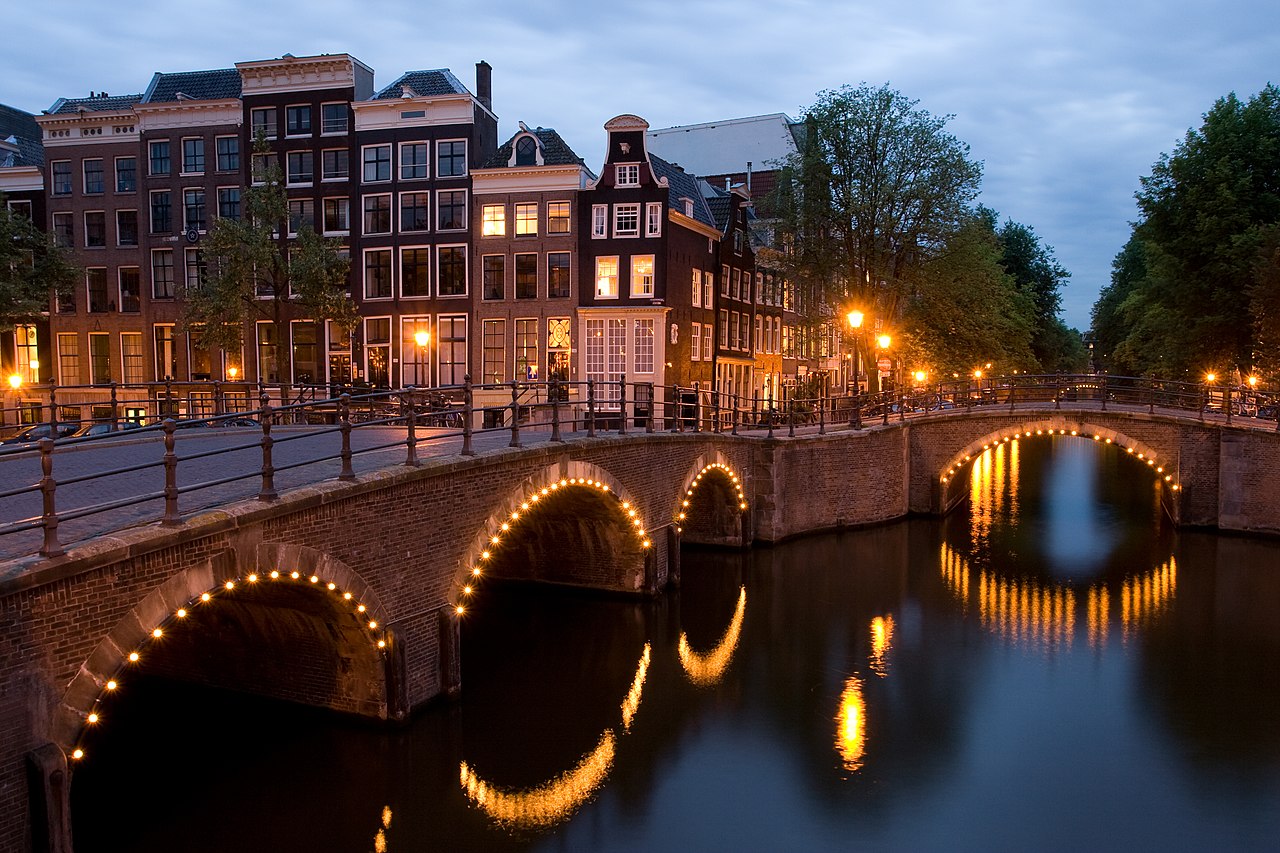
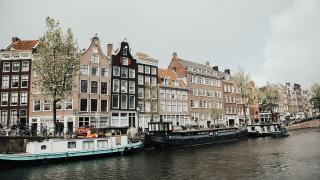
Zigzag south through the three rows, then turn back north along the Prinsengracht. That is the canal in the photograph at the top of this page.
 Evening on one of the Nine Streets canals. Image: Jorge Franganillo, CC BY 4.0, via Wikimedia Commons.
16:30 — The Jordaan, Noordermarkt and Brouwersgracht
North of the Westerkerk the canal ring gives way to the Jordaan, a former working-class district of narrow streets, small canals and courtyards. Walk up the Prinsengracht to the Noordermarkt, the square around the Noorderkerk where a market has been held since 1623. If you are here on a Saturday (09:00–16:00), the organic farmers' market is on. On a Monday (09:00–14:00) there is a flea market instead. On other afternoons the square is quiet.
 The Saturday market on the Noordermarkt. Image: Alf van Beem, Public domain, via Wikimedia Commons.
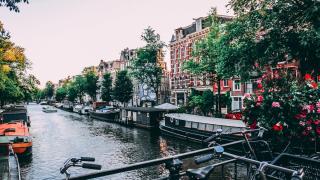
From the Noordermarkt, the Brouwersgracht runs along the northern edge of the canal ring, lined with houseboats and old warehouses. It is one of the most photographed canals in the city, with no single sight to tick off. Walk it to the Herengracht and back.
 Houseboats on the Brouwersgracht. Image: Jvhertum, Public domain, via Wikimedia Commons.
Have an early dinner in the Jordaan. The neighbourhood is full of brown cafés and small restaurants, and you need to be at the Westermarkt by the time your Anne Frank slot starts.
19:00 — Anne Frank House
The Anne Frank House is the canal house at Prinsengracht 263, where Anne Frank, her family and four others hid in the secret annex from 1942 until they were betrayed and arrested in August 1944. The visitor entrance is around the corner at Westermarkt 20, not on the canal side.
The house is open from 09:00 to 22:00 every day. Most visitors spend about an hour inside, and an audio tour in nine languages is included. A few practical points:
- Photography and filming are not allowed inside, and that includes smart glasses.
- Bags larger than A4 are not allowed, and there is no luggage storage, so come without your suitcase.
- The stairs in the annex are very steep.
- The house sometimes keeps shorter hours, for example on 4 May (Remembrance Day) and on Jewish holidays such as Yom Kippur, when it closes. Check the date before booking.
Next door is the Westerkerk, where Rembrandt was buried on 8 October 1669. Exactly where his grave lies is no longer known. The church is open Monday to Friday, 11:00–15:00, so on this route you will see it from outside. The tower cannot be climbed during the current restoration. The three pink granite triangles at the waterside below the church are the Homomonument, unveiled in 1987. It was the first monument in the world to the gay men and lesbians persecuted for their sexuality.
 The Westerkerk from the Prinsengracht: the Anne Frank House is a few doors to the left. Image: Zairon, CC BY-SA 4.0, via Wikimedia Commons.
Getting there and back: no tram stops at Westermarkt until works on Raadhuisstraat finish, which the Anne Frank House expects in 2028. From Centraal it is about a 20-minute walk, or take a tram to Dam and walk 10 minutes. After your visit, walking back to Centraal along the canals takes about 20 minutes.
If you couldn't get Anne Frank tickets: the IJ and A'DAM Lookout
Take the free F3 ferry from behind Centraal Station to Buiksloterweg. It runs day and night, every few minutes, and bikes are allowed. The tower at the landing is A'DAM Lookout, with a viewing deck over the city and the harbour. It is open 10:00–22:00 with last entry at 21:00, and tickets cost €16.50 online (adults, 2026). The "Over the Edge" swing over the roof edge is €7.50 extra.
One common mistake: the ferry to NDSM is a different line, the F4. It goes to the former shipyard further west, not to the tower.
 A'DAM Tower and the IJ, seen from the north bank. Image: MrAronymous, CC0, via Wikimedia Commons.
The day at a glance
| Time | Stop | Allow | Book ahead? |
|---|---|---|---|
| 09:00 | Rijksmuseum | 2 h | Yes, timed ticket |
| 11:15 | Canal cruise from Stadhouderskade | 75 min | Online is cheaper |
| 12:30 | Walk to Spui, lunch | 1 h | No |
| 13:45 | Begijnhof | 30–45 min | No (free) |
| 14:30 | Dam Square, Royal Palace | 1 h | Check the palace calendar |
| 15:30 | Nine Streets, Prinsengracht | 1 h | No |
| 16:30 | Jordaan, Noordermarkt, Brouwersgracht, dinner | 2 h | No |
| 19:00 | Anne Frank House | 1 h | Yes, online only, six weeks ahead |
Practical notes
Getting in from Schiphol. Direct trains to Amsterdam Centraal take 15–17 minutes, run every few minutes during the day and continue through the night. A one-way second-class fare was €5.50 in 2026 if you tap in with a bank card or buy an e-ticket.
Trams and ferries. Amsterdam's trams, metro and buses do not take cash. Tap a contactless bank card or phone on the reader when you get on and when you get off. If you forget to tap out, you are charged a correction fee. A GVB day ticket costs €10 (2026). On this route, though, you may only need one tram ride. The IJ ferries are free and need no ticket.
Bike lanes. The red asphalt is the cycle path, not the pavement. Stepping into it for a photo is the classic first-day mistake. If you find yourself in one, step calmly to the nearest kerb rather than jumping.
Street rules. Drinking alcohol in public is banned in the city centre, and so is smoking cannabis on the street in the Red Light District, on Dam and Damrak and on Nieuwmarkt. Fines start at €100. Since 1 July 2026, shops may not sell alcohol after 22:00. Day visitors pay no tourist tax.
Mondays and holidays. All the main stops on this route are open on Mondays. On King's Day (27 April) the Begijnhof is closed to tourists, the Anne Frank House closes at 17:00 and the centre is packed. On 25 December and 1 January the Nieuwe Kerk is closed, but the Rijksmuseum stays open.
Prices are those published by each attraction in October 2026. Check them when you book.