Renting a holiday apartment in the Netherlands is easy in most of the country, but Amsterdam is the exception: the city caps how many nights residents may rent out their homes, so supply is tight and rules are enforced. Wherever you book, expect tourist tax on top of the rate, and since January 2026 a higher VAT rate on most accommodation.
What counts as a holiday apartment
Several quite different products show up under "apartment" on booking sites, and the rules and prices differ for each.
- Private homes rented by residents (vakantieverhuur). This is the Airbnb-style rental of someone's own home while they are away. In Amsterdam and several other cities this is the most regulated category.
- Short-stay and serviced apartments. Professionally run apartments with a reception or app-based check-in, often aimed at business travellers but bookable by anyone. They operate under their own permits and are not subject to the night limits that apply to private homes.
- Aparthotels. Hotel-style buildings with kitchenettes, common near business districts and train stations.
- Holiday homes and bungalows in holiday parks. Outside the cities, the bungalow park is the classic Dutch self-catering format. Large operators include Center Parcs, Landal GreenParks and Roompot, with parks on the coast, in the Veluwe forests and in Limburg.
Amsterdam's holiday rental rules
Amsterdam residents need a permit and a registration number to rent their main home to tourists, and the number has to appear in the listing. The number of nights is capped: 30 nights a year in most of the city, cut to 15 nights a year from 1 April 2026 in the Centrum district and in the Oude Pijp and Nieuwe Pijp neighbourhoods. Hosts must also notify the city of each stay, and group size is limited, so large groups generally cannot book a private home legally.
For a visitor this has practical consequences:
- Availability is limited, particularly in the canal belt and De Pijp, and prices for legal listings reflect that.
- Check the listing for a registration number. A listing without one, or a host who asks you to say you are a friend or family member, is a warning sign; illegal rentals can be cancelled at short notice.
- Short-stay apartments and aparthotels are often the more reliable option for longer stays or groups, because the night cap does not apply to them.
Several other Dutch municipalities have introduced their own registration requirements for holiday rentals, so the same check is worth doing in Rotterdam, The Hague, Utrecht and elsewhere.
Canal houses and Dutch building quirks
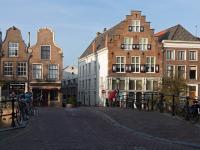
Many city-centre apartments are in old, narrow townhouses, and the layout catches out first-time visitors.
- Stairs are steep and narrow. Dutch staircases in older houses can be close to ladders. If anyone in your group has limited mobility or you have heavy luggage, ask which floor the apartment is on and whether there is a lift; most older buildings have none.
- Hoist beams on the gables are still how furniture goes in through the windows. Your suitcase goes up the stairs.
- Rooms are compact and kitchens small, but usually fully equipped with a hob, fridge, kettle and often a combination microwave oven.
- Houseboats are also rented out in Amsterdam and some other cities. They are subject to the same holiday rental rules as houses.
Where to look outside Amsterdam
Because the Dutch rail network is dense and fast, an apartment in another city can work as a base for Amsterdam day trips.
- Haarlem, Leiden and Utrecht are historic canal towns with regular, direct trains to Amsterdam.
- Rotterdam and The Hague offer more modern apartment stock and good links to the rest of the Randstad.
- The coast (Zandvoort, Noordwijk, Scheveningen, the Zeeland resorts) has many holiday apartments, often rented by the week in summer.
- The Wadden Islands such as Texel and Terschelling rely on holiday homes and apartments; in high season many are only available for full weeks.
All public transport accepts contactless bank cards through the OVpay system: you tap in and tap out on trains, trams, buses and metros.
Costs, taxes and extra fees
The headline price is rarely the total.
| Item | What to expect |
|---|---|
| Tourist tax (toeristenbelasting) | Set by each municipality. Amsterdam charges 12.5% of the room price excluding VAT in 2026, for all accommodation types. Many other towns charge a fixed amount per person per night. |
| VAT | Since 1 January 2026, VAT on overnight stays in hotels, holiday homes and furnished rentals is 21%, up from 9%. |
| Cleaning fee | Common on platform listings and holiday homes; check whether it is included in the total shown. |
| Bed linen and towels | Some holiday parks and holiday homes charge for these separately or expect you to bring your own. |
| Security deposit | Sometimes held on a card and released after departure. |
Platforms usually show tourist tax in the final price, but some hosts collect it on arrival. Ask before you book if it is unclear.
Booking safely
- Book and pay through the platform or the operator's own site. Requests to pay by bank transfer to a private account for a listing you found on a platform are a common scam.
- Read recent reviews and check the address on a map, especially the floor level and whether the building is on a busy nightlife street.
- Confirm check-in arrangements. Many apartments use key boxes or smart locks; know the procedure before you arrive late in the evening.
- Ask about parking if you drive. Street parking in central Amsterdam is expensive and very limited. The city's P+R car parks on the edge of town, combined with public transport, are the usual alternative.
House rules and living like a resident
Dutch apartment buildings are densely packed and neighbours notice noise quickly. Expect house rules about quiet hours, no parties and no smoking indoors. Waste separation is normal: paper, glass and sometimes plastic go into separate street containers, and the host should tell you where they are. Bicycles should not be left in shared hallways. The Netherlands uses 230 V and type F/C plugs, the same as most of continental Europe.