
Two days are enough for the Rotterdam that first-time visitors come for: a food hall with a painted ceiling, tilted yellow houses, a cable-stayed bridge, a museum whose collection lives in a mirrored bowl, and an old harbour district that the 1940 bombing missed. Rotterdam was rebuilt almost from scratch after that raid, so the city rewards walking between buildings rather than queuing outside them. Nothing here needs more than a few tickets, and one of them is for a museum that sells only timed slots.
Saturday covers the centre and the river: the Markthal, the Cube Houses, the Erasmus Bridge, the Kop van Zuid quays and a water taxi to the Euromast for the view at dusk. Sunday is for museums and the oldest harbour: the old port of Delfshaven in the morning, then the Boijmans Van Beuningen Depot and the Kunsthal in the afternoon. The plan assumes you arrive by train from Amsterdam or Schiphol on Saturday morning and leave on Sunday evening. Saturday adds up to about 6 km on foot, plus one short boat ride. Sunday is about 3 km, plus one metro ride.
Book these before you go.
- Boijmans Van Beuningen Depot: entry is by online ticket with a booked start time only, at boijmans.nl. Full price €20, free up to age 18. During the museum's special exhibition (Marisol at the time of writing) a €2.50 supplement is added. The Depot takes cards and phone payments, not cash.
- Kunsthal: online start time required, even with a Museum Card, at kunsthal.nl. Adults €20, under 18 free, students up to 26 €12.50. Payment at the building is by debit card only.
- Fenix (the migration museum on Katendrecht), if you add it to Saturday: the museum asks visitors to buy tickets online first, at fenix.nl. Adults €15, ages 19 to 25 €7.50, up to 18 free.
- Euromast: tickets are cheaper online. The general ticket is €13.50 online and from €17.50 otherwise; the "complete experience" with the Euroscoop is €19.00 online and from €23.50 otherwise. Book at euromast.nl.
- Trains: if you travel on the weekend of 7 and 8 November 2026, read the November note below first. Press reports say no trains run to or from Rotterdam Centraal that weekend, so check ns.nl before you book.
Saturday 09:45 — Laurenskerk: the medieval survivor on the way in
The train from Amsterdam arrives at Rotterdam Centraal, which opened in its current form on 13 March 2014. Walk south-east for about 15 minutes towards the Grotekerkplein. The Laurenskerk is the one big medieval building left in the centre. It was built between 1449 and 1525, and on 14 May 1940 German bombers destroyed about 2.6 km² of central Rotterdam and left roughly 85,000 people homeless. The church was gutted, though its tower and walls stood, and it was rebuilt between 1952 and 1968.
 The Laurenskerk on Grotekerkplein, rebuilt after the 1940 bombing. Image: Michielverbeek, CC BY-SA 4.0, via Wikimedia Commons.
Stop here for the outside and the square. The church is open on only a few days a week and sometimes closes for private events, and its own website gives conflicting hours, so check laurenskerk.nl before you plan to go in. Entry was €4 for adults and the tower climb €7.50 when this was written. Ten minutes is enough for the outside; the Markthal is a five-minute walk away.
10:15 — Markthal: a food hall under an arch of flats
The Markthal opened on 1 October 2014. The Dutch firm MVRDV designed it as an arch of 228 apartments wrapped around a market floor, with glass walls closing the two ends. Inside, a ceiling artwork called Hoorn des Overvloeds (Horn of Plenty), by Arno Coenen and Iris Roskam, covers 11,000 m² of the arch in giant fruit, flowers and insects. It was printed on about 4,000 aluminium panels. There are more than 100 food stalls and restaurants, so this is also where to eat lunch if you want it early.
 The Markthal's arch and glass end wall, seen from the Binnenrotte square. Image: Fred Romero from Paris, France, CC BY 2.0, via Wikimedia Commons.
The hall is open Monday to Thursday 10:00 to 20:00, Friday 10:00 to 21:00, Saturday 10:00 to 20:00 and Sunday 12:00 to 18:00, but each stall sets its own hours. Outside on the Binnenrotte, the open-air Centrum market runs on Tuesdays and Saturdays with more than 450 stalls, so Saturday is the best day to come. Allow 45 minutes to an hour.
11:15 — Cube Houses: living inside a tilted cube
Walk two minutes to the Cube Houses on the Overblaak, beside Blaak station. The architect Piet Blom tipped each home onto one corner and set it on a hexagonal pylon, so that the block of cubes stands like a small forest over a pedestrian walkway. His idea was housing as an "urban roof" that leaves the ground free for the street; the Rotterdam set dates from 1984. There are 38 small cubes and two larger "super-cubes", and people live in them. Take photos from the street and the steps and do not look into windows.
 The Cube Houses on the Overblaak, each home tilted on a corner and set on a hexagonal pylon. Image: Jan Geerling, CC BY-SA 4.0, via Wikimedia Commons.
To see inside, visit the Kijk-Kubus museum house, a furnished cube open to the public. Its operator's pages list adults at €3.50 and daily opening from 10:00 to 18:00, but the English page still carries pandemic notices, so phone +31 10 414 2285 or check kubuswoning.nl before you rely on either figure. Allow 20 to 30 minutes. The pyramid-shaped top room, with 18 windows, is the part to look for.
12:00 — Lunch, then the walk to the Erasmus Bridge
Eat at the Markthal if you did not earlier, or at any of the cafés around the Oude Haven, the small harbour behind the Cube Houses. Then walk south-west towards the river, about 20 minutes and 1.5 km, along the Oude Haven and the Leuvehaven to the north end of the Erasmus Bridge.
13:00 — Erasmus Bridge: 802 metres on foot
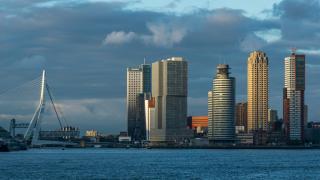
Queen Beatrix opened the bridge on 6 September 1996. It is 802 m long, with a single asymmetrical pylon 139 m high, designed by Ben van Berkel, and the people of Rotterdam call it De Zwaan, the Swan. Two cable-stayed spans carry the road, with a bascule (lifting) section of 89 m for ships. Trams use the middle, and the two pavements and two cycle tracks are cantilevered out on each side, so walking across is easy and takes about 10 minutes. Stay on the pavement, not the red cycle lane.
 The Erasmus Bridge and the Kop van Zuid, seen from the river's north bank. Image: Martin Falbisoner, CC BY-SA 4.0, via Wikimedia Commons.
On the far side you are on the Kop van Zuid, the former dock area that was redeveloped from the 1990s onward. The Wilhelminapier, a promontory of towers and quays, begins here.
13:45 — Hotel New York and the Wilhelminapier
Walk about ten minutes west along the pier to the Hotel New York. The tower of the old Holland America Line headquarters, built in 1917, is easy to spot, and it has been a hotel since 1993. It stands at the head of the pier, next to a water-taxi stop that Watertaxi Rotterdam uses as its home base, with an information desk.
 The former Holland America Line headquarters, now Hotel New York, on the Wilhelminapier. Image: Guilhem Vellut from Annecy, France, CC BY 2.0, via Wikimedia Commons.
You can sit here for a coffee on the quay, or skip ahead to the next stop.
14:15 — Water taxi to Fenix on Katendrecht
Take the water taxi from the Hotel New York stop (number 44) to the Fenix stop (number 50). The boats run on request: you book a ride in the Watertaxi app, on watertaxirotterdam.nl, or by phone (010 403 0303), and you can change or cancel up to 15 minutes before departure. Fares are per person. Inside the Centre zone a ride costs €5.25, and children up to 12 pay half. You can pay in the app or on board by card. The boats take up to 12 passengers, and the service can stop in very heavy storm or ice. The walk is about 25 minutes if you prefer it.
 A Watertaxi Rotterdam boat on the Nieuwe Maas, with the Kop van Zuid behind. Image: Sneeuwvlakte, CC BY-SA 4.0, via Wikimedia Commons.
Fenix opened in May 2025 in a restored 1920s warehouse on the quay at Paul Nijghkade. It is an art museum about migration, and it describes its building as standing on "the quays of departure and arrival". It is open Tuesday to Sunday, 10:00 to 17:00, and closed on Mondays outside school holidays. On the Saturday the museum closes at 17:00, so arrive by 14:30 and give it up to 90 minutes. Admission is €15. If you do not want a museum, walk Katendrecht's quays and skip to the water taxi.
 The Fenix building on Katendrecht, with its steel rooftop sculpture. Image: Mitsjol, CC BY 4.0, via Wikimedia Commons.
16:15 — Water taxi to the Euromast at dusk
Order a second boat from Fenix (stop 50) to the Euromast stop (number 65) at Parkhaven. The price depends on the zones the app shows you before you book; fares are €5.25 inside the Centre zone, €7 inside the East or West zone, €9 across two zones and €15 across three. The Euromast is open every day from 09:30 to 22:00. It closed on 5 January 2026 for a refurbishment of its outside structure and its restaurant, and, according to press reports, visitors were let back in during June 2026.
The Euromast was built between 1958 and 1960 for the Floriade garden show, to a design by Hugh Maaskant. The viewing platforms are at 112 m, and the Euroscoop, a glass cabin, rises to 185 m with a 360-degree view and a glass floor that can turn opaque. The ticket includes The Rise of Rotterdam, a short immersive show about the port. Between November and January the sun sets between about 16:25 and 17:00, so a 16:30 arrival gives you the harbour in daylight and then lit. Allow 1.5 hours.
 The Euromast, a tower built in 1960 for the Floriade garden show, rising from the Park. Image: Thomas Dahlstrøm Nielsen, CC BY 4.0, via Wikimedia Commons.
Saturday evening
The Euromast has its own brasserie, which you can book on the Euromast website. Otherwise take a tram or the metro back towards the centre; check the route on the RET app or 9292, as the nearest stop depends on where you eat. Saturday ends here, with about 6 km walked.
Sunday 09:30 — Delfshaven: the harbour the bombs missed
Take the metro to Delfshaven station, which lines A, B and C serve. From Rotterdam Centraal, ride line D to Beurs and change there (check the RET app; line A does not run on early weekend mornings, so lines B and C are the safe choice). The Delfshaven district was a separate port town before Rotterdam absorbed it, and it escaped the Luftwaffe raid of 14 May 1940. The Voorhaven and Achterhaven, with their gabled brick houses and moored boats, are among the few places in the city that kept their pre-war look.
 The Achterhaven in Delfshaven, with its gabled brick houses and moored boats. Image: Michielverbeek, CC BY-SA 4.0, via Wikimedia Commons.
The Pilgrim Fathers left from here on 1 August 1620 on the Speedwell. The Pelgrimvaderskerk, the Pilgrim Fathers Church, dates from 1417 and is a working Protestant church, with services every Sunday at 10:00 and 17:00. Look at it from outside, since you will not be able to enter during services, and we could not confirm visitor opening hours. Walk the two harbours slowly: allow 75 minutes. Delfshaven is also a water-taxi stop (number 75), so you can come here by boat if you prefer it.
 The Pilgrim Fathers Church, which stands over the Voorhaven in Delfshaven. Image: Jsamwrites, CC BY-SA 4.0, via Wikimedia Commons.
11:15 — Metro to Museumpark
Metro A, B or C to Eendrachtsplein, or tram 7 to Museumpark, puts you at the Depot. The ride from Delfshaven is a few stops and about 10 minutes. Use the walk through the Museumpark to see the two buildings you are visiting from outside.
12:00 — Boijmans Van Beuningen Depot: 155,000 objects, and you can walk between them
The Boijmans Van Beuningen museum's main building on Museumpark has been closed since mid-2019. Construction on its renovation is due to begin at the end of 2026. The museum's own pages give a reopening in 2029; the architects, Mecanoo, now say 2030. Until then the collection is shown in the Depot, next door. Opened on 5 November 2021 and designed by MVRDV, the Depot is a mirrored bowl, and the museum calls it the world's first publicly accessible art storage building. It holds more than 155,000 objects in 14 compartments with five different climates.
 The mirrored surface of the Depot Boijmans Van Beuningen in Museumpark. Image: Spinarak, CC0, via Wikimedia Commons.
You wander through the storage compartments alone or with a guide and can see conservators at work. A ticket does not guarantee a guided compartment tour, so read the start times posted at each compartment door. A compartment takes 13 visitors at a time. The roof, with a view over the city, is included in the ticket. The cloakroom and lockers are free, but backpacks and baby carriers are not allowed inside, and photography is allowed. Children under 6 need an adult with them on tours. Allow 2 hours, and arrive on time: if you are late, the slot cannot be moved and you must buy a new ticket.
The Depot is open Tuesday to Sunday, 11:00 to 17:00, and closed on Mondays. If you want lunch, the Depot has a rooftop restaurant open for coffee and lunch from 10:00 to 16:30 on those days.
14:30 — Kunsthal: the museum without a collection
The Kunsthal stands about five minutes' walk from the Depot, on the Westzeedijk side of the park. Rem Koolhaas and the architect Fuminori Hoshino of OMA designed it, and it opened in 1992. It has no permanent collection and runs more than 20 changing exhibitions a year, so what you see depends on the date. Between late October 2026 and spring 2027 the programme includes Signac: Symphony of Colours (24 October 2026 to 28 February 2027), Plastic Sea, Perfect Storm (3 October 2026 to 7 March 2027), Drawn: Rotterdam! (17 October 2026 to 7 February 2027) and A Chair and You (25 September 2026 to 31 January 2027), and a Sabine Marcelis installation, Continuum, that runs to 23 January 2027.
 The Kunsthal on Westzeedijk, with the towers of the Scheepvaartkwartier behind. Image: Fred Romero from Paris, France, CC BY 2.0, via Wikimedia Commons.
It is open Tuesday to Sunday, 10:00 to 17:00. Allow 90 minutes. If you are short of time, choose the Depot or the Kunsthal, not both. The Depot is the better choice for a collection that spans centuries; the Kunsthal suits a themed exhibition.
16:30 — Back to the station
Collect your bags and take the metro back to Rotterdam Centraal. From Eendrachtsplein change at Beurs, then the D line; check the RET app for the current route. Trains to Amsterdam run from Centraal all evening. You will arrive with time for dinner near the station.
If you come between November and April
- Trains. Dutch rail-news sites reported in October 2026 a "train-free weekend" on 7 and 8 November, with no trains to, from or through Rotterdam Centraal. We found no official NS or ProRail page for it, so check ns.nl and plan this trip for another weekend if it is confirmed.
- Daylight. Sunset falls between about 16:25 and 17:00 from November to January, so do Delfshaven in the morning, as in this plan, and the Euromast at the end of the day.
- Closed days. The Kunsthal is closed on 25 December, 1 January and King's Day (27 April 2027), and opens 10:00 to 16:00 on 24 and 31 December. Fenix is open on public holidays except 25 December. we could not confirm the Depot's holiday opening for 2026–27, so check before you go.
- Water taxi. The boats can stop in a very heavy storm or ice, and in thick fog only the ferries sail.
- Rain. The Markthal, Fenix, the Depot and the Kunsthal are all under cover. On a wet Saturday, spend longer in the Markthal and Fenix, and ride the Euromast on a clear hour rather than at a fixed time.
The weekend at a glance
| Day and time | Stop | Allow | Book ahead? |
|---|---|---|---|
| Sat 09:45 | Laurenskerk (outside) | 10–15 min | No |
| Sat 10:15 | Markthal | 45–60 min | No |
| Sat 11:15 | Cube Houses, Kijk-Kubus | 30 min | No |
| Sat 12:00 | Lunch, walk to the bridge | 1 h | No |
| Sat 13:00 | Erasmus Bridge | 20 min | No |
| Sat 13:45 | Hotel New York, Wilhelminapier | 30 min | No |
| Sat 14:15 | Water taxi, Fenix | 1.5 h | Yes, online ticket |
| Sat 16:15 | Water taxi, Euromast | 1.5 h | Yes, cheaper online |
| Sun 09:30 | Delfshaven | 75 min | No |
| Sun 12:00 | Boijmans Van Beuningen Depot | 2 h | Yes, timed slot |
| Sun 14:30 | Kunsthal | 1.5 h | Yes, start time |
| Sun 16:30 | Metro to Centraal, train | 1 h | No |
Practical notes
Getting there. From Amsterdam Centraal a regular Intercity runs directly to Rotterdam Centraal in about 70 minutes. The faster Intercity direct leaves from Amsterdam Zuid and takes under 40 minutes; between Schiphol and Rotterdam it needs a supplement on top of the ticket, which was reported at €3.20 for a single use in 2026. we could not confirm the 2026 single fare, so check the NS app or ns.nl.
Paying for transport. Rotterdam's RET metro, tram and bus accept a contactless bank card or phone through OVpay. Tap in and tap out at every stop with the same card, and the day's fares are taken from your account the following day. Sales of the anonymous OV-chipkaart were reported to end on 1 July 2026, so a bank card or phone is the simplest way. RET sells an unlimited day ticket for €12. The Rotterdam City Card costs €17.50 for one day and €25 for two days with unlimited RET travel, and gives at least 25% off at more than 50 museums and attractions. It does not cover NS trains or water taxis, so it pays off only if you use several of the discounted places.
Cash and cards. The Depot takes cards and phone payments only, the Kunsthal accepts debit cards only and the water taxi takes a card on board.
Mondays. The Kunsthal, the Depot and Fenix are closed on Mondays, apart from some Monday holidays at the Kunsthal and school holidays at Fenix, which is why this plan runs Saturday and Sunday.
What first-timers get wrong. They try to go inside the Boijmans museum building and find it closed since 2019; the Depot is the place to see the collection. They expect to walk into the Cube Houses; only the Kijk-Kubus is open to visitors, and the rest are homes. And they arrive at the Depot without a ticket.
Prices and times are as published by each operator in October 2026. Check them when you book.