







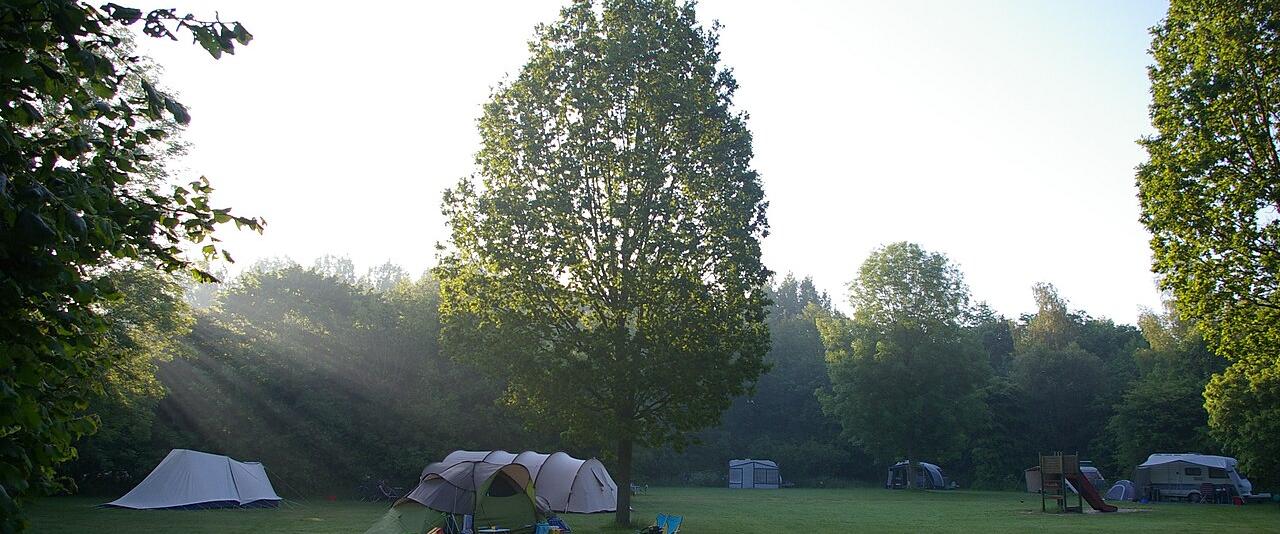
Camping in the Netherlands means staying on a campsite: wild camping is not allowed anywhere in the country, and the choice runs from large holiday parks to small farm sites with a handful of pitches, simple nature campsites near the dunes and forests, and glamping tents. The country is small and flat, trains and cycle paths reach almost everywhere, and you are rarely more than an hour from the coast, a forest or a lake. This guide covers the types of campsite, the rules, the main regions and how to book.
Quick facts (checked October 2026)
- Wild camping: not allowed. Natuurmonumenten, which manages many Dutch nature reserves, says plainly that real wild camping is permitted nowhere in the Netherlands.
- The fine: on Texel, the fixed penalty for pitching a tent or camper outside a campsite is €160, and the legal maximum is much higher (details below).
- Small farm campsites: booked through networks such as SVR, which lists more than 2,000 affiliated boerencampings; you need to become a donor to get the SVR rate.
- Nature campsites: the Natuurkampeerterreinen network has more than 150 sites; you must show a Natuurkampeerkaart on arrival.
- Emergency number: 112.
Is wild camping legal in the Netherlands?
No. Dutch municipalities ban recreational overnight stays in a tent, caravan or camper outside a designated campsite through their local bylaws (the APV). Texel's council set out exactly how this works in a written answer to councillors in June 2024: article 4:18 of the island's APV forbids placing camping gear for an overnight stay outside a campsite, another article forbids sleeping in a vehicle or caravan on a public road between 23:00 and 07:00, and a third forbids sleeping in the open air in public places, the beach included, between 23:00 and 07:00.
Breaking the ban is a criminal offence. The Public Prosecution Service has set a standard penalty for it, and on Texel that fine is €160. The legal maximum is a second-category fine, which the council put at €5,150. Fines can be issued by police and by enforcement officers (BOAs), including those working for Staatsbosbeheer and Natuurmonumenten. Other municipalities have their own APV, so the wording varies, but the principle is the same everywhere: camp on a campsite.
What about "pole camping"? For years the state forest service, Staatsbosbeheer, ran paalkampeerterreinen: a marker pole in the woods where you could pitch a small tent for free. In May 2020 Staatsbosbeheer closed all 17 of its pole-camping sites with immediate effect, citing litter, illegal campfires, large groups and people staying too long. At the time, around thirty such sites run by other landowners remained. If you want something close to wild camping, look at Natuurmonumenten's canoe-camping spots in De Wieden (Overijssel), where you can camp on platforms with no facilities, or at the nature campsites below.
Types of campsite
Large campsites and holiday parks
Most visitors stay on a full-service campsite with marked pitches, electricity, a shower block and often a shop, play area and swimming pool. These are the easiest option for families and for anyone arriving with a car and a big tent or caravan. They also tend to have rental tents, chalets and mobile homes if you would rather not bring your own gear.
 Dunes and heath beside a campsite at Den Hoorn on Texel, with the village church on the skyline. Image: Txllxt TxllxT, CC BY-SA 4.0, via Wikimedia Commons.
Minicampings and boerencampings (farm campsites)
A minicamping is a small campsite, often on a working farm, with a limited number of pitches and simple facilities. They are quieter and cheaper than the big parks, and you camp in a field with a view of the polder rather than in a row of hedged plots. Many are grouped in networks. SVR (Stichting Vrije Recreatie) lists more than 2,000 affiliated farm campsites in the Netherlands and elsewhere in Europe; to pay the SVR rate you first become a donor of the foundation.
 A minicamping: a mown field, a few caravans and tents, and a single toilet block. Image: Lucas Mevius, CC BY-SA 3.0, via Wikimedia Commons.
Nature campsites (natuurkampeerterreinen)
The Natuurkampeerterreinen network, run by the foundation De Groene Koepel, has more than 150 approved campsites in places such as orchards, estates, forests, the coast and even inside old fort walls. They are basic and quiet. You need a Natuurkampeerkaart to stay: you show it to the site manager on arrival, it is valid for one calendar year, and one card covers up to four people on one pitch.
Natuurmonumenten also lists campsites next to its own reserves, among them Camping Seedune on Schiermonnikoog and Camping de Lepelaar by the Zwanenwater in North Holland.
 Tents under the trees on a sandy nature campsite. Image: Hanno Lans, CC BY 4.0, via Wikimedia Commons.
Glamping and huts
If you want a bed without a caravan, look for safari tents, tiny houses and trekkershutten: small wooden hikers' huts with beds, found on many campsites and aimed at walkers and cyclists. Natuurmonumenten lists glamping on the island of Tiengemeten in South Holland.
 A trekkershut, a simple hikers' cabin, with a small toilet block beside it. Image: Frank Markesteijn, CC BY-SA 4.0, via Wikimedia Commons.
Where to camp: the main regions
The North Sea coast and the dunes
The coast from Zeeland to North Holland is the most popular camping area. Sites sit behind the dunes, a short walk or bike ride from the beach. The beaches are long and sandy and are covered in our guide to the best beaches in the Netherlands. Coastal sites fill up first in July and August.
The Wadden Islands
Texel, Vlieland, Terschelling, Ameland and Schiermonnikoog have campsites among the dunes, and they are some of the most sought-after pitches in the country. Texel is the easiest to reach: the TESO ferry from Den Helder does not take reservations, so you simply turn up. Remember the island rules: on Texel, sleeping on the beach at night is explicitly banned.
The Veluwe
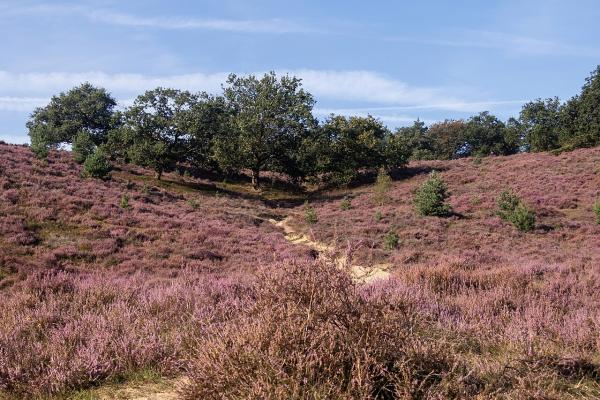
The Veluwe in Gelderland is one of the country's largest areas of forest and heath, and it has a long camping tradition. In the summer of 1967 a press photographer recorded its campsites "packed full". Today it suits campers who want to cycle and walk among pines and purple heather, which flowers in late summer. De Hoge Veluwe National Park, which is open every day of the year, has its own campsite near the Hoenderloo entrance; ask the park's reservations desk about availability.
 Heath and old pines on the Tongerense Heide in the Veluwe, at the end of August. Image: Agnes Monkelbaan, CC BY-SA 4.0, via Wikimedia Commons.
Zeeland
Zeeland in the south-west mixes beaches, dikes and old towns, with many farm campsites behind the coast. Distances are short and flat, which makes it good for cycling with children; see our route ideas for cycling Zeeland's dikes.
Near the cities
You do not need a car to camp. Amsterdam has campsites on the edge of the city with tram or bus links to the centre, so you can pitch a tent and still see the museums.
 Tents on a city campsite on the eastern edge of Amsterdam. Image: Jenna Post, CC BY-SA 4.0, via Wikimedia Commons.
When to go camping in the Netherlands
The camping season runs from spring to autumn, and many campsites close in winter; each site sets its own dates, so check before you travel. July and August are the busiest months, when Dutch school holidays fill the coast and the islands. May, June and September are quieter and often dry and mild, though nights can be cool. Bring rain gear in any month: the Dutch weather changes quickly. For what to pack, see our Netherlands packing list.
 A crowded campsite in the Veluwe during the summer holidays of 1967. Image: Eric Koch for Anefo, CC0, via Wikimedia Commons.
How to book
- Large campsites: book directly with the campsite or through its own website. For July and August on the coast or the islands, book early.
- Farm and small campsites: check the network's rules first. SVR sites require donorship; natuurkampeerterreinen require the Natuurkampeerkaart.
- Arriving by bike or on foot: many sites keep a few pitches or trekkershutten for walkers and cyclists, but this varies; ask ahead in high season.
- Prices: these vary too much by site, season and pitch type to quote a reliable range. Compare the site's own price list, and check whether tourist tax (toeristenbelasting), electricity and showers are included.
Camping with kids
The Netherlands is an easy country for a family camping trip. Distances are short, cycle paths are separated from traffic, and many big campsites have pools, playgrounds and organised activities in summer. Farm campsites appeal to younger children because of the animals. On the coast, use the guarded swimming zones on the beach, and keep children away from the water when a red flag is flying.
Practical tips
- Fires: open fires are generally not allowed outside the places a campsite permits. Ask the site, and watch for fire-risk warnings in dry summers.
- Ferries and islands: check the ferry operator's rules for cars, bikes and luggage before you pack a large tent.
- Bikes: almost every campsite rents bikes or is near a rental shop, and the Dutch cycle network is the best way to explore.
- Waste: take your rubbish with you or use the campsite's sorting system.
- Sleeping in your car or van: the same local rules apply. On Texel it is banned on public roads between 23:00 and 07:00; use a campsite or an official motorhome pitch.
If the weather turns
Many campsites rent chalets, huts or safari tents with solid floors, so a wet forecast does not have to end a trip. Indoor options near the main camping areas include museums in the coastal towns, the visitor centres of the national parks and, on the Veluwe, the Kröller-Müller Museum inside De Hoge Veluwe.


._30-08-2021._(actm.)_06.jpg)

