







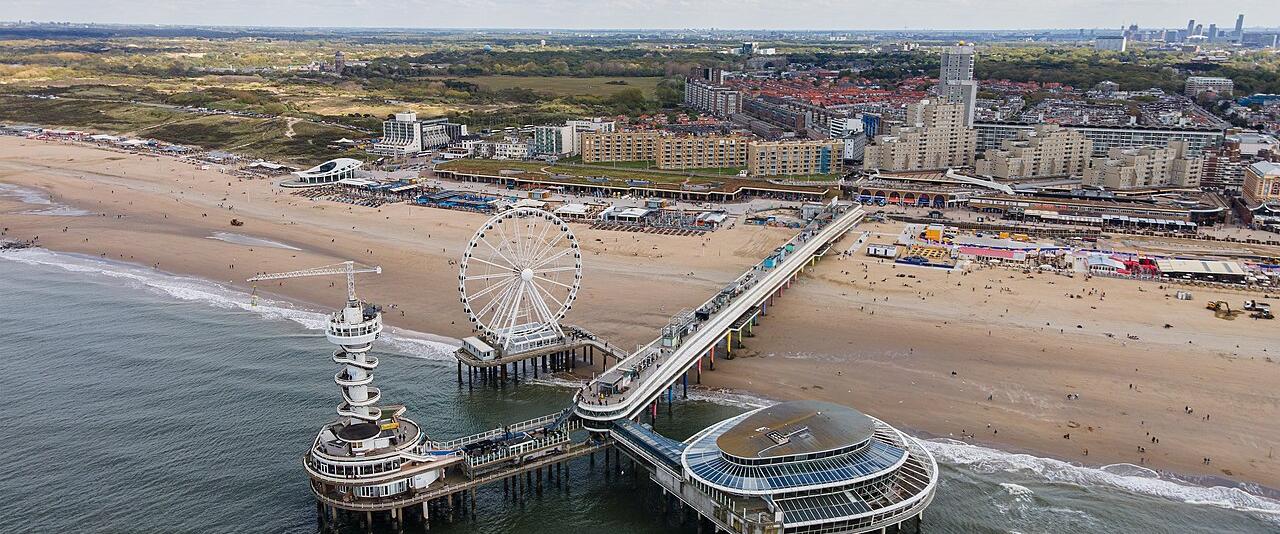
The best beaches in the Netherlands are on the North Sea coast: Scheveningen, Zandvoort, Noordwijk and Bloemendaal for an easy day out from the cities, the Wadden islands of Texel and Terschelling for space and dunes, and Domburg and Cadzand in Zeeland for quieter family beaches. The whole coast is one long run of wide, sandy beach backed by dunes, and the official bathing season runs from 1 May to 1 October. The sea is cool, the wind is constant and the water can be dangerous, so it pays to know the flags. This guide covers each beach, how to get there by public transport, swimming safety and when to go.
Quick facts (checked October 2026)
- Bathing season: 1 May to 1 October. During the season the provinces test the water at official swimming spots every 14 days; results are on zwemwater.nl.
- Sea temperature: under 2 °C along the coast in February, above 20 °C in August, according to the KNMI weather institute. The sea is warmest at the end of August.
- Flags: swim between the red-and-yellow flags; a red flag means do not swim.
- Lifeguards: mostly in the summer months, and only on parts of each beach.
- Emergency number: 112.
Scheveningen: the big city beach
Scheveningen is The Hague's beach and the best-known seaside resort in the country. The long promenade, the Kurhaus hotel, the pier and the Ferris wheel make it the most built-up stretch of coast, with rows of beach pavilions in front of the Kurhaus that, the city's tourism office says, make it a beach for "365 days a year". North of the harbour the beach is quieter, and to the south lies the smaller resort of Kijkduin.
Getting there: from Den Haag Centraal take tram 9 towards Scheveningen Noord, or bus 22 towards Duindorp, which stops along the coast. Bus 24 runs to Kijkduin. A two-hour HTM tram ticket costs €4.70 and a day ticket €8.30 (2026 fares). For more on The Hague's beaches, see our Scheveningen summer beach guide.
Zandvoort: Amsterdam's beach
Zandvoort is the nearest beach to Amsterdam and the easiest to reach without a car: there is a direct train from Amsterdam and Haarlem to Zandvoort aan Zee station, a few minutes' walk from the sand. The beach is lined with pavilions near the village and becomes quieter the further you walk north or south. Behind it lie dunes and a national park where wisent (European bison) graze.
 A path through the dunes down to a beach pavilion at Zandvoort. Image: G.Lanting, CC BY 4.0, via Wikimedia Commons.
Bloemendaal aan Zee
Just north of Zandvoort, Bloemendaal aan Zee is a small cluster of beach pavilions in the dunes rather than a town. It is known for its beach clubs, which draw a younger crowd on summer evenings. During the day it is a good choice if you want a wide beach without a resort behind it. Most visitors come by bike or bus from Haarlem, or walk along the beach from Zandvoort.
 Beach pavilions in the dunes at Bloemendaal aan Zee. Image: G.Lanting, CC BY 4.0, via Wikimedia Commons.
Noordwijk
Noordwijk, between The Hague and Zandvoort, is a classic Dutch seaside resort with a long boulevard, hotels facing the sea and a wide beach. It feels calmer than Scheveningen and Zandvoort and suits families. Noordwijk has no railway station: take the train to Leiden Centraal and a bus from there to the coast.
Texel
Texel, the largest of the Wadden Islands, has one long beach down its North Sea side, backed by high dunes and marked by numbered beach posts (paal), which are the easiest way to say where you are. The beaches are wide enough that even in August you can find space. The TESO ferry from Den Helder takes no reservations: you simply turn up. On the island, rent a bike and follow the cycle paths behind the dunes.
Note the local rule: on Texel it is forbidden to sleep on the beach between 23:00 and 07:00.
 The beach and dunes on Texel's North Sea side, near beach post 9. Image: Pa3ems, CC BY-SA 4.0, via Wikimedia Commons.
Terschelling
Terschelling is longer and quieter than Texel, with long beaches on its North Sea side and wide salt marsh and tidal flats on the Wadden side. Ferries run from Harlingen (Rederij Doeksen); book ahead in summer. KNRM lifeguards guard parts of the beach in the summer season. Like the other islands, it is best explored by bike.
 The beach and tidal flats near West-Terschelling. Image: Smiley.toerist, CC BY-SA 4.0, via Wikimedia Commons.
Zeeland: Domburg and Cadzand
The beaches of Zeeland, in the south-west, face the North Sea along the dunes of Walcheren and Zeeuws-Vlaanderen. Domburg is an old seaside resort on Walcheren, with a high dune above the beach and rows of colourful beach huts; buses run from Middelburg station. Cadzand-Bad, near the Belgian border, is smaller, with a long beach backed by dunes and breakwaters. Zeeland's beaches are generally less crowded than those of Holland, and the area is good for combining a beach stay with cycling along the dikes.
 The dune, beach huts and pavilion at Domburg on Walcheren. Image: G.Lanting, CC BY 4.0, via Wikimedia Commons.
 Dunes and beach at Cadzand-Bad, near the Belgian border. Image: Marc Ryckaert, CC BY-SA 4.0, via Wikimedia Commons.
Is it safe to swim in the North Sea?
It can be, if you swim in the right place. The North Sea has strong currents, and the most dangerous are rip currents (muien): channels where water flows back out to sea between sandbanks. Rijksoverheid, the Dutch government, advises swimming only at official swimming spots.
What do the beach flags mean?
Reddingsbrigade Nederland, the lifeguard association, introduced a simpler set of flags with icons and short texts in 2025, starting in The Hague. On a beach you may see the old or the new set:
- Red-and-yellow flags at the waterline: the guarded swimming zone. Swim between them; water sports are not allowed there.
- Yellow flag: dangerous conditions; swimming is not recommended and you should be extra careful. Yellow beach flags at the waterline mark a zone with a rip current.
- Red flag: very dangerous; do not swim.
The double red flag and the white flag with a blue question mark have been dropped. There is no green flag: the government notes that even Blue Flag beaches no longer use one, because a green flag suggests swimming is safe when there is always some risk. Beaches are not legally required to fly flags at all, so no flag does not mean the water is safe.
 A lifeguard post on the beach at Scheveningen. Image: FaceMePLS from The Hague, The Netherlands, CC BY 2.0, via Wikimedia Commons.
When are there lifeguards?
Lifeguards work mainly in the summer months and only on guarded sections of each beach, marked by the red-and-yellow flags. On the Wadden islands, KNRM lifeguards guard beaches on Vlieland, Terschelling, Ameland and Schiermonnikoog, and in Wassenaar on the mainland. The daily guarded period on the islands has typically covered July and August (in 2020, for example, 4 July to 30 August, with extra weekends either side on Ameland). Check the local times at the beach entrance, on the municipality's site or, for the islands, at knrm.nl.
How cold is the North Sea?
Cold by Mediterranean standards. The KNMI says coastal water ranges from under 2 °C in February to over 20 °C in August, and the sea reaches its warmest at the end of August. Summers are getting warmer: in August 2026 a measuring station about 30 km off Hoek van Holland recorded a daily average of 21.5 °C, the highest since records there began in 1984. In June the water is still noticeably cooler, so a wetsuit makes a swim far more comfortable outside high summer.
Beach pavilions and the beach season
The beach pavilions (strandpaviljoens) are the restaurants, cafés and beach clubs that stand on the sand. Most open in spring and close in autumn, but some, especially in the larger resorts such as Scheveningen, stay open all year. Opening dates and hours are set by each pavilion and municipality, so check before a winter or shoulder-season trip. Many rent sunbeds and windbreaks in summer.
When to go
- June: long days and quieter beaches, but the water is still cool.
- July and August: the warmest water, lifeguards on duty and the most open pavilions. Also the busiest, especially on hot weekends and during Dutch school holidays.
- September: the sea is still close to its warmest, and the beaches empty out. The bathing season officially runs to 1 October.
- Winter: good for long beach walks and pavilions with a view, not for swimming.
Practical tips
- Go by train: on hot summer days the coastal roads and car parks fill up; Zandvoort has a direct train, and Scheveningen a tram from The Hague Central.
- Bring a windbreak or layers: there is almost always wind on the coast.
- Check the water quality: zwemwater.nl shows the latest results for official swimming spots, including any swimming advice or ban.
- Watch the tide on the islands: tidal flats can flood quickly on the Wadden side; stay on the North Sea beaches unless you are with a guide.
- Plan an island trip: check the ferry timetable, and allow time for the crossing and for getting to the beach on the far side of the island.




.jpg)