


A Garden Older Than Most Dutch Cities' Landmarks
The Hortus Botanicus in Leiden was founded in 1590 by Leiden University as a teaching garden for medical students, who needed to learn to recognise medicinal plants. That makes it the oldest botanical garden in the Netherlands and one of the oldest in the world. It still belongs to the university, but it is open to the public and draws more than 250,000 visitors a year.
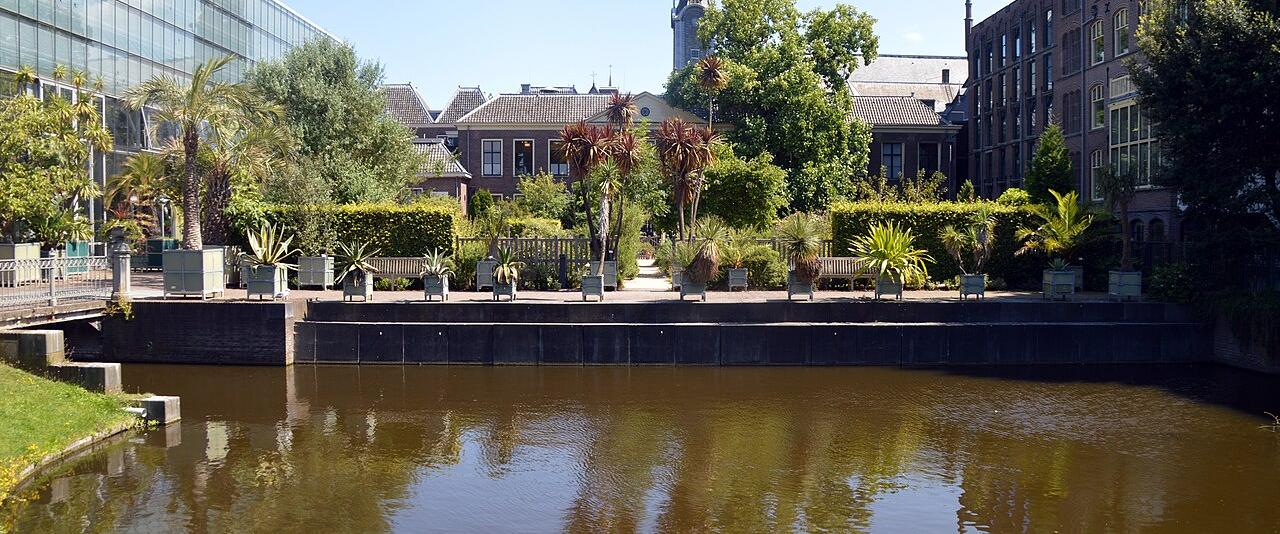
The garden lies in the historic centre at Rapenburg 73, behind the university's Academy Building on Leiden's best-known canal.
The Clusius Garden
In 1593 the botanist Carolus Clusius arrived in Leiden to run the garden. He built up a collection of more than 1,000 species in a plot of roughly 35 by 40 metres, and he used contacts with merchants and the Dutch East India Company to obtain plants from abroad. Clusius is also closely associated with the early spread of tulips in the Netherlands; he grew them in Leiden in the 1590s, decades before the tulip trade turned into the speculative mania of the 1630s.
A reconstruction of his original garden, laid out according to a plant list from the late 16th century, opened in 2009. It is a compact, formal space of rectangular beds, and it gives a clear sense of how a Renaissance teaching garden worked: plants arranged for study rather than display. Visit in April and May to see the historic tulip varieties in flower.
Historic Trees
Several trees in the Hortus are among the oldest planted trees in the country:
- a tulip tree (Liriodendron tulipifera) planted in 1716
- a golden chain tree (Laburnum) planted in 1725
- a date plum (Diospyros lotus) from 1739
- a ginkgo dating from 1785
The laburnum is propped up with supports but still flowers yellow in late spring. These trees were planted when the garden was a working teaching collection, and they have survived storms, wars and several redesigns of the beds around them. Look for the labels at the base of each tree, which give species and planting dates.
Greenhouses and the Orangery
The Hortus had greenhouses from the late 17th century, and its Orangery, used to overwinter tender plants in tubs, was built between 1740 and 1744. The modern glasshouses hold tropical and subtropical collections, and they make the garden worth visiting in winter as well as summer.
Highlights include:
- Victoria amazonica, the giant Amazon water lily, whose leaves can grow well over a metre across, best seen in summer
- Amorphophallus titanum, the titan arum, which flowers only rarely and attracts crowds when it does; the garden announces flowerings on its website and social media
- large collections of Asian orchids, carnivorous Nepenthes pitcher plants, Hoya, Dischidia, aroids and ferns, several of which are scientifically important reference collections
The Japanese Garden and Siebold
Philipp Franz von Siebold, a German physician who worked for the Dutch at Dejima in Japan from 1823 to 1829, sent many Japanese plants back to Leiden, and some of the species he introduced to Europe are still in the garden. The Japanese garden in the Hortus, opened in 1990, honours him.
To follow the Siebold story further, Japanmuseum SieboldHuis, in the house where he lived on the Rapenburg, is a short walk away and displays objects from his collection.
When to Visit
- April and May: spring bulbs, historic tulips in the Clusius garden and blossom
- June to August: the Victoria water lily, the borders at their fullest and long opening days
- Autumn: leaf colour on the old trees, including the ginkgo
- Winter: the greenhouses carry the visit, and the garden is quieter
Allow one and a half to two hours to see the outdoor garden and the glasshouses without rushing.
Practical Information
- Getting there: the Hortus is about a 15 to 20-minute walk from Leiden Centraal station through the old centre. Trains from Amsterdam and The Hague reach Leiden in well under an hour.
- Tickets: there is an admission charge, and opening hours change between summer and winter. Check current prices and times on the Hortus website before you go.
- Combining: Leiden's other museums are within walking distance, including Naturalis, Rijksmuseum van Oudheden and Museum De Lakenhal. In spring, the Keukenhof bulb gardens near Lisse are a short bus ride north, and the bulb fields around them complete the tulip story Clusius started.