Why Maastricht Is Different
Maastricht, in the far south of the Netherlands between Belgium and Germany, is one of the oldest cities in the country. It grew around a Roman crossing of the river Maas (Meuse), and its medieval street plan, stone churches and surviving walls give it a very different feel from the brick canal cities of Holland. The centre is compact and flat, so the walk below can be done in half a day, or stretched over a full day with time inside the churches and museums.
Begin on the river. The Sint Servaasbrug replaced the old Roman bridge after it collapsed in 1275, and parts of the present structure date from the 13th century, making it the oldest bridge in the Netherlands. It was partly paid for with church indulgences. Walk across from the Wyck district on the east bank for a view of the old town's skyline, then head into the centre.
Vrijthof and Its Churches
The Vrijthof is Maastricht's largest square and the setting for many of its events. On its west side stands the Basilica of Saint Servatius. The first stone church was built over the grave of Saint Servatius around 570, and the present building is mostly Romanesque, with a massive westwork and 12th- and 13th-century sculpture. His tomb in the crypt has drawn pilgrims for centuries, and the church treasury holds medieval reliquaries and textiles.
Next to it is the Gothic Sint-Janskerk, with its red-painted tower, and across the square is the Spanish Government Building, a reminder of Habsburg rule. Climbing the Sint-Janskerk tower, when open, gives a view over the old town. The Spanish Government Building houses the Museum aan het Vrijthof, a small museum of art and city history. In summer the square is also the venue for André Rieu's open-air concerts, so check the city's events calendar if you want to see the Vrijthof without stages and crowds.
Onze Lieve Vrouweplein
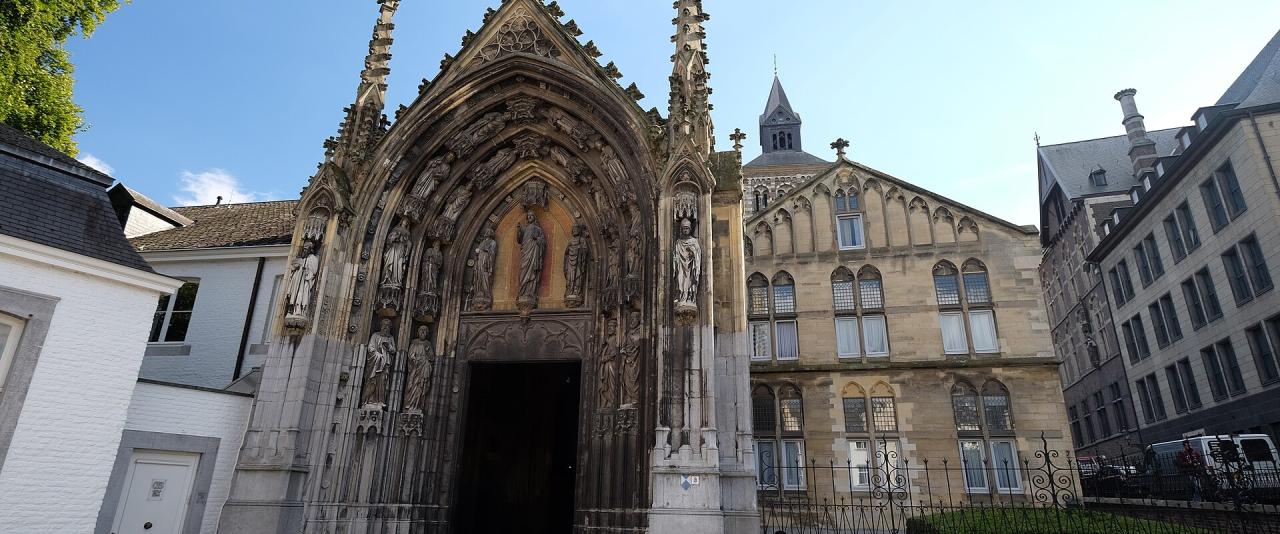
A few minutes south-east lies the Basilica of Our Lady. Parts of the church date from the 11th century, including a fortress-like westwork in the Mosan style of the Meuse valley. In a Gothic chapel next to the church is the shrine of Our Lady, Star of the Sea, the city's most venerated image. The square in front is lined with cafes under trees and is a good place for a break.
The Helpoort and the City Walls
From Onze Lieve Vrouweplein, walk south along the remains of the medieval walls. Maastricht kept substantial parts of its first and second medieval walls and several towers from the 13th and 14th centuries. The highlight is the Helpoort, a gate with two towers built around 1230, the oldest surviving city gate in the Netherlands. The walk along the wall and the green park below it, the Stadspark, is one of the most attractive in the city.
The Jekerkwartier
West of the Helpoort is the Jekerkwartier, named after the small river Jeker that runs through it. This is the quietest and most picturesque part of the centre, with narrow lanes, water mills and old houses. Its buildings include the 13th-century First Franciscan Monastery and several 17th-century monasteries, and much of Maastricht University is housed in the area, which gives it a lively student presence during term.
Markt, Stadhuis and Dominicanen
Finish in the north of the centre at the Markt. Its town hall, designed by Pieter Post in the 17th century, is considered one of the finest examples of Dutch Baroque architecture. Nearby, the late medieval Dinghuis has an early Renaissance facade and houses the tourist information office.
Between the Markt and the Vrijthof, a 13th-century Dominican church has been converted into a bookshop. In 2008 The Guardian called it the most beautiful bookshop in the world, and it is worth stepping inside for the vaulted nave alone.
Practical Tips
Maastricht station is in the Wyck district, about a 10- to 15-minute walk from the Vrijthof across the river. The old town is largely pedestrian-friendly, but cobbles make comfortable shoes essential. Churches have their own opening hours and the treasuries charge admission, so check times in advance if you want to see the interiors. If you have more time, the Bonnefanten Museum, in the Céramique district on the east bank, and the tunnels and fort on the Sint Pietersberg south of the centre make good additions.