What Terpen Are
Terpen (in Groningen called wierden) are artificial dwelling mounds built along the Wadden Sea coast of the northern Netherlands before the land was protected by dikes. From around 600 BC, people living on the salt marshes raised their farms on mounds of clay, sods and manure so that houses and livestock stayed dry when storm tides flooded the land. Over centuries, as mounds were raised and joined, some grew into village-sized hills.
Once dikes were built in the Middle Ages, the mounds were no longer needed for safety, but villages stayed on them. Many were later partly dug away, because terp soil was rich and was sold as fertiliser, especially in the 19th and early 20th centuries. Those excavations also uncovered much of what archaeologists now know about the people who built them.
Hegebeintum: The Highest Terp
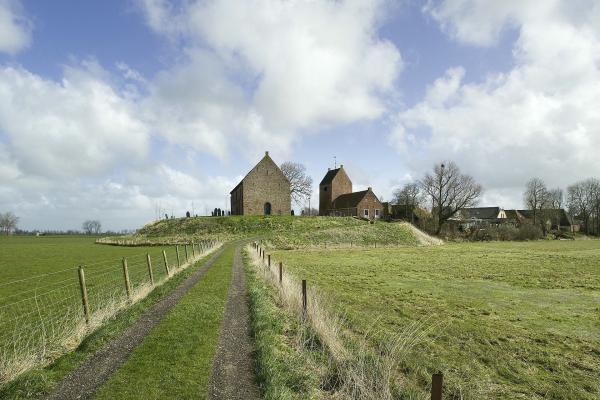
Hegebeintum, about 15 kilometres north of Leeuwarden in Friesland, stands on the highest terp in the Netherlands, around 8.8 metres tall. Much of it was dug away between 1896 and 1905, but the church still sits on top of the remaining mound, surrounded by the old graveyard, and the slope is obvious as you walk up.
The village has a knowledge and information centre about the terp, with an exhibition on the terp landscape and archaeological finds that opened in 2021. From the centre, a walking and cycling route of about 10 km there and back leads to Blije, where a new "terp of the future" has been built behind the sea dike, a modern take on the old idea of living above the water.
Ezinge and the Wierden of Groningen
In Groningen, the village of Ezinge sits on a large wierde that was excavated in the 1920s and 1930s. Archaeologists found the remains of dozens of farms and outbuildings spanning roughly a thousand years, from around 600 BC to the fifth century AD. The Wierdenland museum in Ezinge explains the site and the wider wierden landscape.
North Groningen has many other villages on mounds, often with a medieval brick church at the highest point and streets curving around it in rings. Driving or cycling between them, you can see how each village rises slightly above the flat fields around it.
Routes to Follow
The terp landscape is best explored by bike, because the villages are several kilometres apart, though shorter walks are possible around individual mounds.
- Archaeological Wadden route, Friesland (part 2): A cycling route of about 59 km starting in Firdgum that passes Hegebeintum and other sites.
- Hegebeintum to Blije: A walking or cycling route of about 10 km there and back from the Hegebeintum centre to the new terp at Blije.
- Wierdenroute, Groningen: A route of about 40 km through the wierden villages of the province.
- Route of Five Mounds: A loop of about 20 km through the old wierden landscape of Groningen.
Four small archaeological museums along the Wadden coast, including those in Firdgum, Oude Bildtzijl and Hegebeintum, work together under the name Terpenland. Check opening times before you go, as several open only part of the year or on certain days.
When to Go and What to Bring
Late spring to early autumn is the most comfortable time to visit. The landscape is open and very exposed to wind, so plan cycling routes with the wind direction in mind, and bring a windproof layer even in summer. Facilities between villages are limited, so carry water and snacks, and note that small museums and cafés may be closed on Mondays or outside the main season.
The Dutch cycle-node network (knooppunten) covers the whole area and makes it easy to link villages into a loop of your own.
Nearby: The Wadden Sea Coast
The terpen exist because of the Wadden Sea, which has been a UNESCO World Heritage site since 2009. From the coast, you can join a guided mudflat walk (wadlopen) at low tide, which is only allowed with a licensed guide; trips run mainly in the warmer months and depart from places such as Pieterburen in Groningen. Walking on the sea dike itself gives wide views over the tidal flats.
For a broader introduction to rural life in the north, the Openluchtmuseum Het Hoogeland in Warffum, Groningen, shows historic houses and workshops from the region.