What Is a Terp?
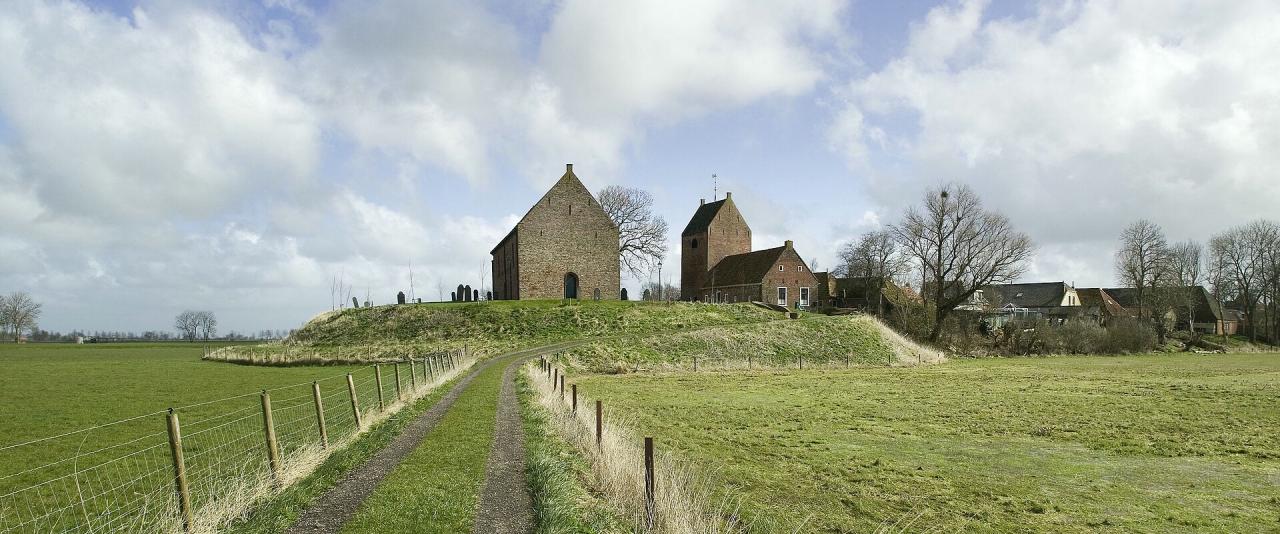
A terp (plural terpen) is an artificial mound built to keep a farm or village above flood level. In the province of Groningen the same mounds are called wierden. Before the first sea dikes, the coastal salt marshes of what are now Friesland and Groningen flooded regularly during storm tides. From around 600 to 500 BC, people began to live on these fertile marshes, first on low natural ridges and then on mounds they raised themselves with layers of clay sods, manure and household waste.
Mounds grew over many centuries as settlements expanded and storm floods rose higher. A single farm mound could grow into a village terp several hundred metres across. The tallest reached around eight to nine metres above sea level. Once dikes were built in the Middle Ages, new terpen were no longer needed, but the old mounds remained, and many villages in the north still stand on them today, often with the church on the highest point and lanes running down the slopes.
Why So Many Terpen Disappeared
Terp soil was exceptionally fertile because of all the organic waste mixed into it. In the 19th and early 20th centuries, many terpen were partly or completely dug away and the soil was sold as fertiliser for poorer farmland elsewhere. The digging destroyed much of the landscape, but it also brought large numbers of archaeological finds to light, and it led to the first scientific excavations. The terpen that survive intact are now protected monuments.
Hegebeintum: The Highest Terp
The village of Hegebeintum (Hogebeintum in Dutch), north of Leeuwarden, sits on the highest surviving terp in the Netherlands, rising about 8.8 metres. A small church crowns the mound, and the view over the flat farmland shows clearly how the terp once stood above the marsh. The oldest traces of settlement here date back to around 600 BC.
At the foot of the mound, a visitor centre opened in 2021 explains the terp landscape and displays archaeological finds in cooperation with the Fries Museum. It is a good first stop for understanding the region before exploring further.
Ezinge and Museum Wierdenland
Ezinge, in the west of Groningen province, is one of the most important wierden in Dutch archaeology. Between 1923 and 1934, archaeologist Albert Egges van Giffen excavated part of the mound and found the remains of dozens of farmhouses and outbuildings spanning roughly 600 BC to the 5th century AD, showing how the settlement was raised and rebuilt over centuries.
Museum Wierdenland in Ezinge presents finds from the excavation, including a reconstructed section of a farmhouse, and explains daily life on the mounds. The wierde itself, with its church on top, is a short walk away; a small monument marks the excavation area. Opening days are limited, so check the museum's website before visiting.
Warffum, Wierum and the Wadden Coast
In Warffum, north Groningen, the open-air museum Het Hoogeland stands on the village wierde. Its historic houses and shops show rural life in the region from around 1750 to 1950, so it is more about later village life than prehistory, but it shows how communities continued to live on these mounds for centuries.
Wierum, on the Frisian Wadden coast, is a terp village right against the sea dike. The northern part of its terp was washed away by the Wadden Sea, which gives the medieval church an off-centre position. A monument on the dike remembers the 1 December 1893 storm, in which 17 of the village's 22 fishing boats were lost and 32 people died. From the dike you look out over the Wadden Sea, a UNESCO World Heritage Site.
Treasures in the Fries Museum
The Fries Museum in Leeuwarden holds the best-known treasure from a terp: the Wijnaldum brooch, an elaborate gold and garnet fibula from around AD 600. A labourer found the first piece in 1953 while digging a ditch on the Tjitsma terp near Wijnaldum, and further fragments surfaced over the following decades. The museum's archaeology displays put it in the context of the Frisian kingdoms of the early Middle Ages.
Exploring by Bike or Car
The terp landscape is best seen slowly. Cycling routes through north Friesland and north Groningen link terp villages, churches and sea dikes using the numbered junction network, and the flat terrain suits most riders, though wind can be strong. Leeuwarden and Groningen are good bases with train connections, but many of the villages are served only by infrequent buses, so a bike or car gives you much more freedom.
A suggested route: start at Hegebeintum's visitor centre, continue to the Wadden dike at Wierum, then cross into Groningen for Ezinge and Warffum on a second day.