What Bourtange Is
Bourtange is a small fortified village in the municipality of Westerwolde, in the far east of Groningen province, a few kilometres from the German border. William of Orange ordered the fort built during the Eighty Years' War to control the only road between Germany and Spanish-held Groningen, and it was completed in 1593. It sits on a sand ridge in what was once a large peat bog, the Bourtanger Moor, and the marshes were as much a defence as the walls.
The fort held out against a Spanish siege soon after it was built and against the forces of the Prince-Bishop of Münster in 1672. It lost its military role in 1851 and became an ordinary village. From the 1960s the local government decided to restore it to its appearance of around 1740 to 1750, and the work, completed by 1992, rebuilt the earthen ramparts, moats and many buildings. Today it is an open-air museum and a village of a few hundred residents.
The Star Shape: Getting the Classic View
Bourtange is a star fort: earthen bastions project from a central core so that defenders could cover every approach with crossfire, and moats surround the works. The famous view of this geometry is from the air, and almost every widely shared image of the full star is an aerial shot.
Drone flying in the Netherlands is regulated, with many no-fly and restricted zones, and rules can apply locally around monuments and villages. Check the official Dutch drone map and the current regulations before planning an aerial shot, and do not assume it is allowed.
From the ground, you can still show the shape by walking the ramparts. The top of the walls gives you angled views along the bastions with the water below, and the corners where two faces of a bastion meet show the geometry best. A wide-angle lens helps.
Inside the Walls
The streets radiate from a central square, the Marktplein, with trees and low brick buildings around it. This layout is easiest to show from a corner of the square looking down one of the radial streets towards the ramparts.
Subjects worth looking for:
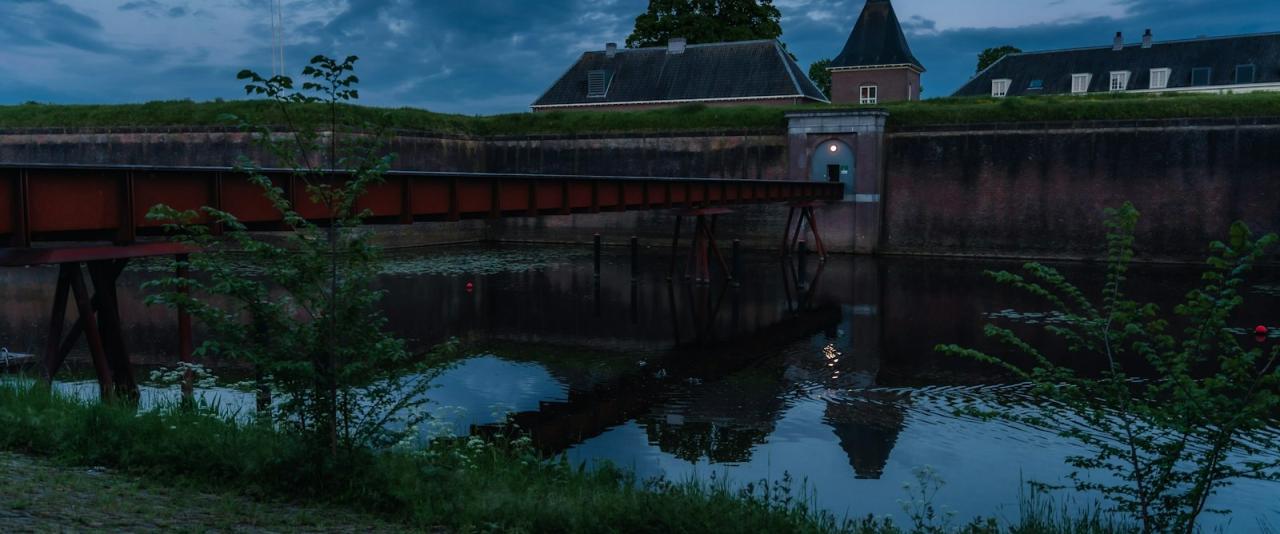
- The wooden bridges and gates: the approaches cross the moats on wooden bridges to gatehouses in the earthworks. They are among the most photographed parts of the fort, especially with reflections on calm water.
- The windmill: a wooden mill on the ramparts gives a strong vertical against the flat ramparts.
- The former synagogue: now a museum, it is a reminder of the Jewish community that lived in the village.
- The church and the 18th-century houses: brick, shutters and cobbles reward close-up and detail shots.
- Living history: at times the fort hosts demonstrations of pike drill, musket fire and cannon firing. These are good for action shots but draw crowds, so check the programme on the fort's official website before you go.
Light and Seasons
The ramparts run in every direction, so there is good light at any time of day somewhere in the fort. For the classic shot of bridge, gate and moat, early morning and the last hour before sunset give low light and, with little wind, clear reflections in the water. Midday in summer is the flattest light and the busiest time.
Autumn and winter suit the fort well. Bare trees reveal the lines of the earthworks, morning mist on the moats is common in the colder months, and frost or a light snowfall outlines the ramparts. Spring and early summer bring green grass on the walls and blossom in the village.
Respecting a Living Village
Bourtange is a real village, and many of the historic houses are homes or holiday rentals. Do not photograph into windows or block doorways, keep tripods out of the way on narrow streets, and stay on paths on the ramparts, which are grass-covered earth that erodes when people cut corners.
Practical Information
- Getting there: Bourtange is in a rural corner of the country, and the easiest way to reach it is by car. Public transport involves a train to a regional station plus a bus; use the 9292 journey planner for current connections.
- Museums and tickets: several small museum buildings in the fort, including the former synagogue, are covered by an admission ticket. Walking the streets and ramparts is free. Check the fort's official website for current opening times, prices and events.
- Where to stay: some historic buildings inside the walls are rented as accommodation, which lets you photograph at dawn and dusk before and after day visitors.
- Combining: the fort is close to the German border, and the surrounding Westerwolde area has quiet countryside for cycling.