Eindhoven calls itself the City of Light, and the name has a practical origin: this is where Philips started making light bulbs in 1891, and the company shaped the city for most of the following century. Today that history shows up in two ways visitors can enjoy. One is GLOW, a free light art festival every November. The other is a design scene built around Design Academy Eindhoven, Dutch Design Week and the former Philips industrial sites.
GLOW Eindhoven 2026: Dates and Basics
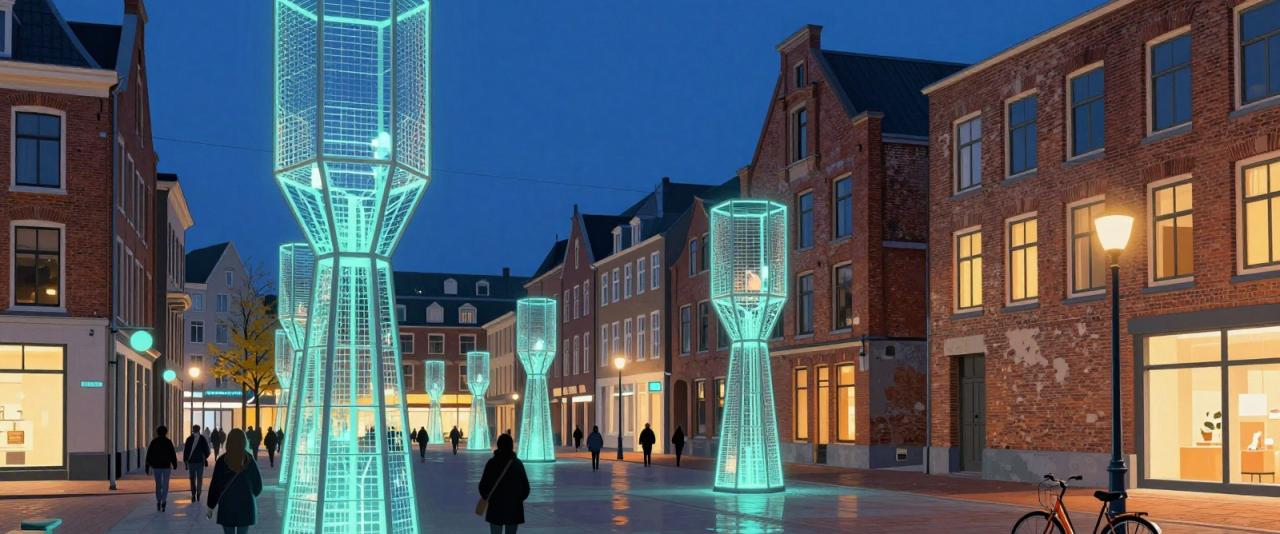
GLOW 2026 runs from 7 to 14 November 2026 under the theme "Connect", which focuses on encounters between people, technology and the environment. According to the organisers, the festival is free and takes place in public space. In Eindhoven the artworks are switched on from 18:30 to 23:00 each evening. Smaller GLOW locations in Best, Oirschot, Veldhoven, Lieshout and Helmond run from 18:30 to 22:00.
The main route is a walk of about 5 km through the city centre with around 30 light artworks. There is no fixed starting point; you can join anywhere, and printed maps are available at information points including Stadhuisplein and the Heuvel. A ticket is only needed for a separate drone experience at the Philips Stadium, which is booked through the festival website.
How to Walk the Route
The route mixes large projections on buildings, interactive installations and smaller pieces in squares and side streets. A few practical points make the evening easier:
- Allow two to three hours. Five kilometres is not far, but crowds slow you down at popular works.
- Go early in the week or early in the evening. GLOW draws large crowds, and the weekend evenings are the busiest. Arriving at 18:30 on a weekday gives you more space.
- Dress for November. It is usually cold and often wet, and you will be outside the whole time.
- Accessibility: the organisers describe the route as fully wheelchair accessible, and the municipality publishes an accessibility map with toilets, water points and rest areas.
- Health warning: the organisers advise people with photosensitive epilepsy not to visit, because some works use flickering and flashing light.
Getting There
The organisers recommend public transport or cycling. Eindhoven Centraal and Strijp-S stations are both close to the route, and you can pay for trains and buses directly with a contactless bank card or phone (OVpay). Driving is discouraged: several central roads close to traffic from 18:00 to midnight during the festival. Eindhoven is roughly an hour and a half by direct train from Amsterdam, so a day trip is possible, but staying the night lets you see the route without watching the clock.
Strijp-S: From Philips Factory to Creative District
Strijp-S, west of the centre, was a closed Philips industrial complex for decades. It has been redeveloped into a district of lofts, studios, shops and event venues in the former factory buildings, and it is one of the main locations during Dutch Design Week. It is worth a visit at any time of year for the architecture alone: large concrete halls, raised walkways and old industrial structures reused for new purposes. Strijp-S has its own train station, so it is easy to combine with the city centre.
Dutch Design Week
Each October, Dutch Design Week turns Eindhoven into the largest design event in Northern Europe, with exhibitions, graduation shows and installations spread across dozens of venues. The graduation show of Design Academy Eindhoven is one of its best-known parts. If you are interested in contemporary design, October is arguably a better time to visit than November, though some light-based work appears at both events. Check the official Dutch Design Week site for the year's dates and venues, as some exhibitions charge admission.
Philips History and Year-Round Sights
- Philips Museum, in the centre, is housed in the building where the company began producing light bulbs and tells the story of the company and its products.
- Van Abbemuseum is Eindhoven's museum of modern and contemporary art, with a strong collection of twentieth-century work.
- The Evoluon, a saucer-shaped building from 1966 that was originally a Philips science museum, is now a conference venue; it is a landmark seen from outside rather than a regular attraction.
Together these give the light festival some context: GLOW is not a random winter event but a modern expression of a city built on lighting technology.
Planning Tips
- Hotels fill up during GLOW and Dutch Design Week, so book well ahead if you want to stay overnight.
- Combine the two halves of the city: daytime in Strijp-S and the museums, evening on the GLOW route.
- Check the GLOW website shortly before you go for the final route map, any changes to opening hours and weather-related updates.