







The Dutch foods to try are raw herring (haring), bitterballen, kibbeling, stroopwafels, poffertjes, cheese, pea soup (erwtensoep), stamppot, apple pie (appeltaart) and the Indonesian rijsttafel, and most of them are cheapest and best from a market stall, a snack bar or a brown café rather than a restaurant. Dutch food is plain, filling and built for cold weather, with one big exception: the colonial history with Indonesia gave the country one of Europe's richest rice-table traditions. This guide covers what to eat, where to find it, the cheese markets and how food tours work.
Quick facts (checked October 2026)
- New-season herring (Hollandse Nieuwe): usually arrives in mid-June; Amsterdam's tourism board says raw herring is at its best from May to July.
- Winter dishes: erwtensoep, stamppot and oliebollen (around New Year's Eve).
- Cheese markets: Alkmaar, Gouda and Edam hold summer cheese markets; the 2026 seasons have ended and 2027 dates were not yet published at the time of writing.
- Cheese: about 60% of Dutch cow's milk goes into cheese, according to the national tourism board.
Haring: raw herring
Raw herring is the Dutch food visitors either love or avoid. It is lightly brined, not cooked, and sold from herring carts (haringkarren) and fish stalls all over the country. You can eat it the traditional way, held by the tail and lowered into your mouth (haringhappen), or as a broodje haring, in a soft white roll with chopped raw onion (uitjes) and pickles (zuur).
The new season's catch, Hollandse Nieuwe, usually arrives in mid-June, and herring signs stay up all year. The national tourism board names Stellendam, Katwijk and Scheveningen as fishing towns to taste it close to the sea.
 A herring cart on the Grote Markt in Haarlem. Image: ctsnow, CC BY 2.0, via Wikimedia Commons.
Kibbeling and other fish-stall snacks
If raw fish is not for you, order kibbeling: battered, deep-fried chunks of white fish, usually cod, served hot with a garlic or herb mayonnaise and a slice of lemon. Fish stalls also sell smoked eel (gerookte paling) on a roll, mackerel salad rolls and shrimp rolls. Weekly street markets almost always have a fish stall, which is the easiest place to try all of these.
Bitterballen and the snack bar
Bitterballen are small, round, deep-fried balls of thick meat ragout with a crisp breadcrumb shell, served with mustard for dipping. They are the standard bar snack in a Dutch café, ordered with a beer at the end of the working day. Wait a minute before biting: the inside stays very hot. The larger, cylinder-shaped kroket is the same idea and comes on its own or on a bread roll.
 Bitterballen with mustard, the standard Dutch bar snack. Image: Andy Li, CC0, via Wikimedia Commons.
The snackbar is where Dutch people buy fried food: kroketten, frikandellen and patat (fries), served in a paper cone. Two orders to know: patatje oorlog, with peanut satay sauce, mayonnaise and onions, and patat speciaal, with curry ketchup, mayonnaise and onions.
FEBO and the wall of hatches
FEBO is the best-known Dutch automatiek: a wall of small glass hatches, each holding a hot snack. You pay at the machine and open the door to take your kroket. It is a quick, cheap and very Dutch late-night stop, and you will find branches in most city centres.
 A FEBO automatiek in Utrecht, with its wall of snack hatches. Image: FaceMePLS from The Hague, The Netherlands, CC BY 2.0, via Wikimedia Commons.
Stroopwafels and poffertjes
A stroopwafel is two thin waffle layers joined by caramel-like syrup. The story goes that a baker in Gouda made the first ones by accident around 1810, from leftover dough and syrup, and called them "poor man's cookies". The packaged ones are everywhere, but a fresh stroopwafel, pressed and filled in front of you at a market stall, is warm and soft and a different thing.
 A stall holder making fresh stroopwafels at a street market. Image: Andy Mabbett, CC BY-SA 3.0, via Wikimedia Commons.
Poffertjes are small, puffy, buttery pancakes, cooked in a special pan with round hollows and served in a stack with butter and powdered sugar. Look for them at markets, fairs and pancake houses. Pancake houses also serve the large Dutch pancake (pannenkoek), sweet or savoury.
Erwtensoep and stamppot: winter food
Erwtensoep, also called snert, is a thick split-pea soup with pork, celery, onion and leek, traditionally sold to skaters on frozen canals. It is usually served with rye bread and bacon (katenspek). A good one is thick enough to stand a spoon in.
Stamppot is potatoes mashed together with a vegetable, such as kale (boerenkool), sauerkraut (zuurkool) or carrots and onions (hutspot), and usually served with a smoked sausage. It is home cooking for cold evenings, and you will find it on the menus of traditional Dutch restaurants in winter.
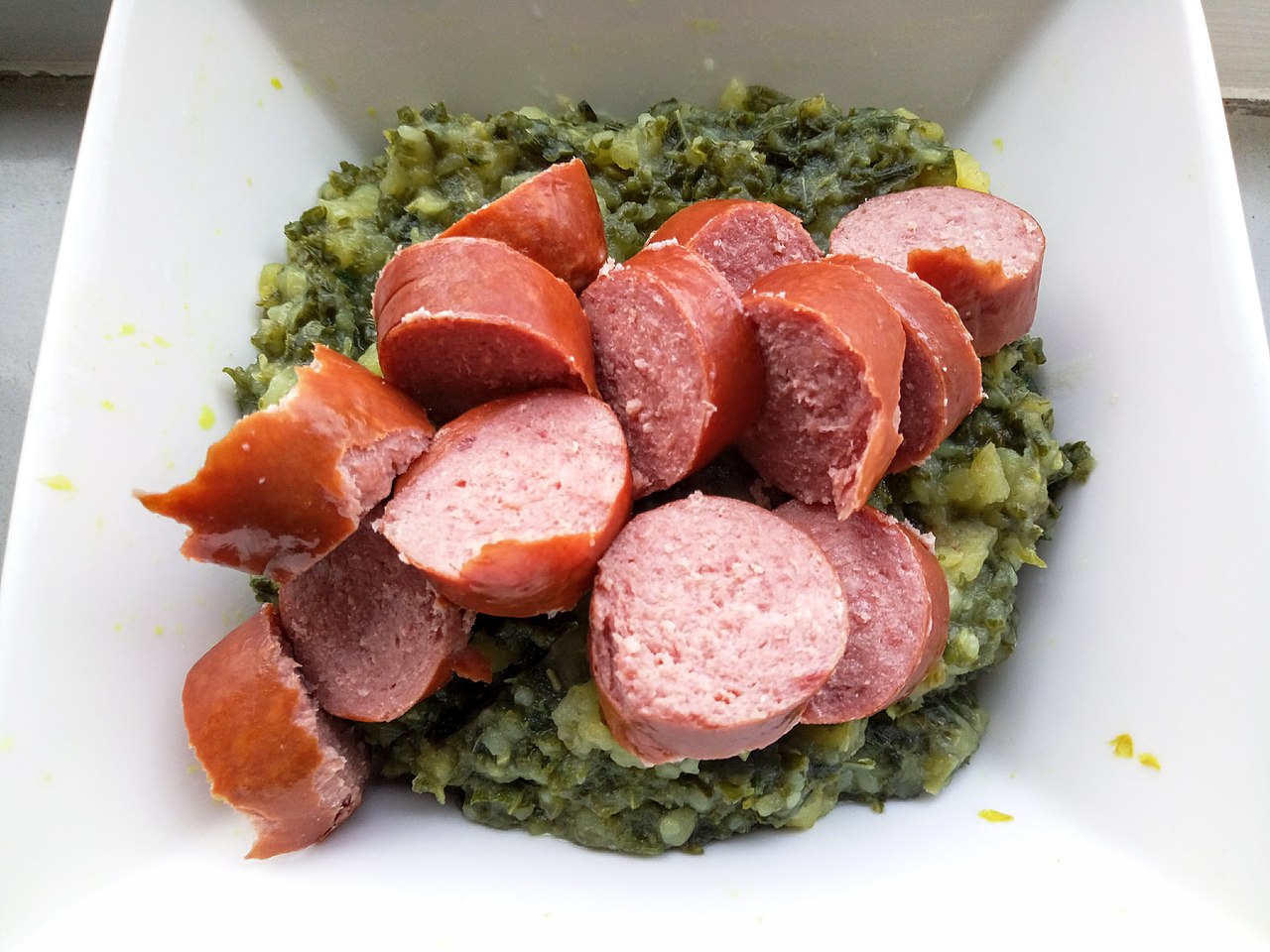 Boerenkool stamppot, potatoes mashed with kale, topped with smoked sausage. Image: Amin, CC BY-SA 4.0, via Wikimedia Commons.
Appeltaart
Dutch apple pie is deep, with a lattice top, cinnamon-spiced apples and often raisins, and it comes with a large spoonful of whipped cream (slagroom). Ask for appeltaart met slagroom. It is the classic order with coffee in an afternoon café.
Kaas: Dutch cheese
Cheese is the Netherlands' best-known food export. Gouda and Edam are the names everyone knows, and the tourism boards also point to goat's cheese (geitenkaas), Maasdammer and Frisian clove cheese (nagelkaas). Young cheese (jong) is mild and soft; aged cheese (oud or belegen) is firmer, saltier and crumblier. Cheese shops and market stalls usually let you taste a slice before you buy.
When are the Dutch cheese markets?
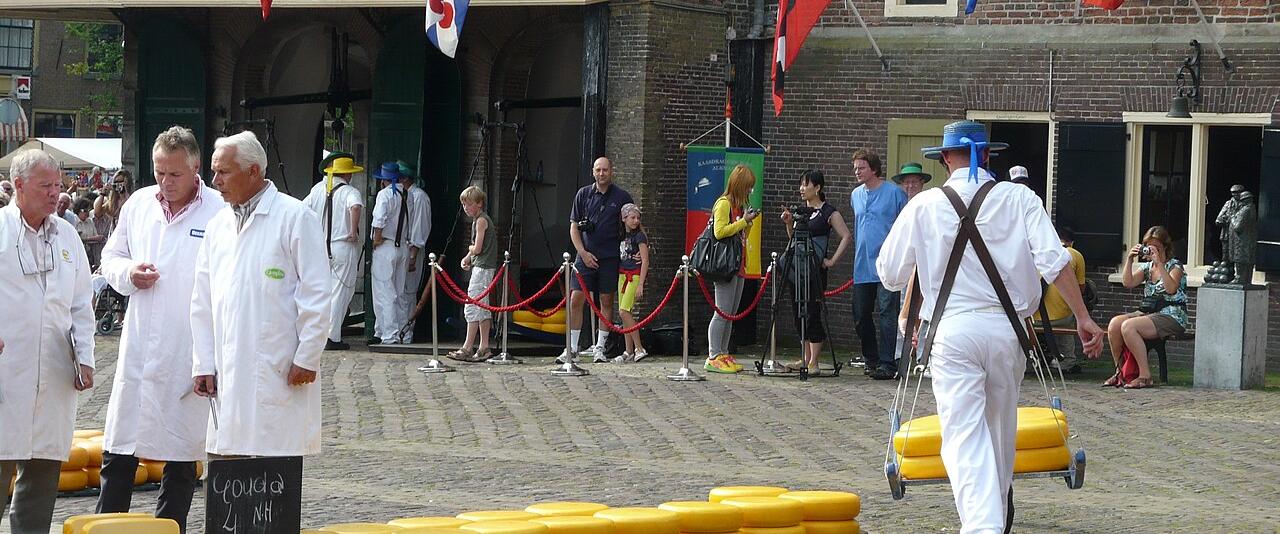
The traditional cheese markets are summer events, held in the morning on the old weigh-house squares, with porters, traders and cheeses laid out on the ground. The 2026 seasons have all ended, and 2027 dates had not been published when this guide was written. The 2026 dates give a good guide to what to expect:
- Alkmaar: every Friday from 27 March to 25 September 2026, 10:00 to 13:00, on the Waagplein, about 15 minutes' walk from the station. In July and August there was also a Tuesday evening market, 19:00 to 21:00.
- Gouda: Thursday mornings from 2 April until the end of August 2026, 10:00 to 12:30, on the Markt by the Waag (weigh house) (no market on 14 May, Ascension Day).
- Edam: Wednesdays from 1 July to 19 August 2026, 10:30 to 12:30, on the Jan Nieuwenhuizenplein, plus an evening market on Saturday 8 August, 20:30 to 22:00.
Check the official Alkmaar, Gouda and Edam sites in early spring for the 2027 dates. Arrive early for a place at the front.
 Cheese wheels, a horse-drawn cart and traders in costume at the Gouda cheese market. Image: Gabriel, CC BY-SA 4.0, via Wikimedia Commons.
Indonesian food and the rijsttafel
The rijsttafel ("rice table") is a spread of many small Indonesian dishes served with rice: satay, curried meats, vegetables in peanut sauce, egg dishes, sambal and crackers. It was most likely conceived by Dutch colonists in the former Dutch East Indies, and it is still served in many Indonesian restaurants across the country. It works best for two or more people. Indonesian and Surinamese food is also part of everyday eating: look for nasi goreng, loempia (spring rolls) and Surinamese roti.
 A rijsttafel: a row of small Indonesian dishes served with rice. Image: Milliped, CC BY-SA 4.0, via Wikimedia Commons.
Where to eat Dutch food
- Street markets: the weekly market in any town is the best single place to try herring, kibbeling, stroopwafels and cheese.
- Fish stalls and herring carts: for haring and kibbeling.
- Snack bars and FEBO: for kroketten, frikandellen and patat.
- Brown cafés (bruine kroegen): for bitterballen with a beer.
- Pancake houses: for pannenkoeken and poffertjes.
- Indonesian restaurants: for a rijsttafel.
For saving money while you eat your way round, see our guide to budget eating in the Netherlands.
How Dutch food tours work
Food tours are a quick way to try many of these things in one afternoon. Most follow the same pattern: a small group walks for a few hours through one neighbourhood or market with a guide, stopping at a series of shops, stalls and cafés for a tasting at each, often herring, cheese, bitterballen, stroopwafels and a drink. The tastings are usually included in the price. When you compare tours, check what is included, how many stops there are, the group size, and whether they can cater for vegetarians or allergies (herring and bitterballen are not easy to swap). You can also make your own: a morning at a street market and an evening in a brown café cover most of this list.
Seasonal food to look for
- Spring: white asparagus from Limburg and Brabant, served with butter sauce, ham and egg; the season runs from April to late June.
- Summer: Hollandse Nieuwe herring and cherries from the Betuwe orchards.
- Winter: erwtensoep, stamppot and, around New Year's Eve, oliebollen, deep-fried dough balls dusted with powdered sugar.



.jpg)


