Outside Amsterdam, the best Dutch food experiences are tied to place and season: summer cheese markets in Alkmaar, Gouda and Edam, mussels and oysters in Zeeland, vlaai in Limburg, and the covered Markthal in Rotterdam. A regional food trip works best as a do-it-yourself itinerary by train, built around market days and harvest seasons rather than one guided tour.
Cheese markets and cheese towns
The traditional cheese markets of North and South Holland are now mostly held for visitors, but they still show how cheese was weighed and traded, and the towns around them are full of cheese shops and farms.
| Market | Day | Season |
|---|---|---|
| Alkmaar | Friday morning | April to the end of September |
| Gouda | Thursday morning | summer months |
| Edam | Wednesday morning | July and August |
Alkmaar is the largest and best known: cheese carriers in guild uniforms carry wheels on wooden barrows across the square in front of the Waag, the old weigh house. It is about 30–40 minutes by direct train from Amsterdam. Arrive early to get a place at the barriers.
Gouda holds its market in front of its Gothic town hall, and the Goudse Waag (weigh house) tells the story of the town's cheese trade. Gouda cheese is made all over the country, but the name itself is not tied to the town; the protected versions are Noord-Hollandse Gouda and Gouda Holland.
Edam, north of Amsterdam, is a small town with canals and a summer market.
Outside market days, many dairy farms in the Green Heart (Groene Hart) around Gouda and Woerden sell farmhouse cheese (boerenkaas), made from raw milk, directly at the farm. Look for signs saying kaas te koop.
Seasons and hours change from year to year; check the local tourist office before planning a trip around a market.
Rotterdam: Markthal and a modern food city
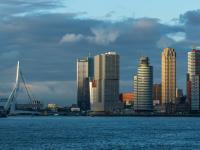
Rotterdam's Markthal, a horseshoe-shaped market hall with apartments arching over a covered market, opened in 2014 and is the easiest one-stop food destination in the city. Inside are fresh-food stalls, delicatessens and small restaurants; on certain days an outdoor market sets up next to it on the Binnenrotte.
Rotterdam's population includes large Surinamese, Antillean, Cape Verdean, Turkish and Moroccan communities, and the food scene reflects that more than any traditional Dutch menu. The streets around Witte de Withstraat and the Katendrecht peninsula are good bases for eating, and Afrikaanderwijk has one of the city's large street markets.
Nearby Schiedam was the centre of jenever distilling, with tall windmills that once ground grain for the distilleries; its Jenever Museum explains the process and pours tastings.
Zeeland: mussels, oysters and the coast
Zeeland, in the south-west, is the seafood province. Yerseke, on the Oosterschelde, is the centre of the Dutch mussel and oyster trade, and its harbour has restaurants and shops selling them directly.
- Zeeland mussels (Zeeuwse mosselen) are traditionally eaten from the start of the season in summer through the following spring, steamed with celery and onion and served with fries.
- Zeeland oysters (Zeeuwse oesters), both the flat native oyster and the larger Japanese oyster, are farmed in the Oosterschelde.
- Zeeuwse bolus is a sticky, spiralled brown-sugar bun eaten with coffee.
Zeeland is best explored by car or bike; Middelburg, the provincial capital, is a good base with direct trains from the rest of the country.
Southern specialities: Limburg and Brabant
Limburg, in the far south, has a food culture closer to Belgium and Germany. Limburgse vlaai is the province's best-known product: a fruit or custard tart on a yeast-dough base, served by the slice in cafés. Maastricht has a strong café culture and a busy market on Wednesdays and Fridays. Limburg is also one of the main Dutch wine regions, with vineyards on the hills south of Maastricht.
North Brabant is known for worstenbrood, a sausage-meat roll in soft bread, sold in bakeries throughout the province, and for its carnival season, when it is eaten in quantity. Brabant cafés serve a wide range of Belgian-style beer.
Northern and eastern flavours
- Friesland: suikerbrôle, a sweet bread with lumps of sugar and cinnamon.
- Groningen: mustard soup (mosterdsoep) and Groninger koek, a spiced cake.
- Deventer: Deventer koek, a honey and spice cake with a long history in the town.
- Gelderland: rookworst, smoked sausage, often eaten with stamppot.
- Texel: lamb and sheep's milk cheese from the island's many sheep.
Most of these are sold in local bakeries and butchers rather than in restaurants, so they are easy to try on a day visit.
Seasonal foods across the country
| Season | What to look for |
|---|---|
| Spring | White asparagus (asperges), mainly from Limburg and Brabant, served with ham, egg and butter |
| June | The first Hollandse Nieuwe herring of the season |
| Summer | Strawberries, cheese markets, Zeeland mussel season starts |
| Autumn | Game, pumpkin, stamppot weather |
| Winter | Erwtensoep (thick pea soup), oliebollen, Sinterklaas sweets such as pepernoten and speculaas |
Asparagus season traditionally ends on 24 June. Oliebollen stalls appear in late autumn and close soon after New Year.
Planning a regional food trip
- Use the train. NS connects Alkmaar, Gouda, Rotterdam, Schiedam, Middelburg, Maastricht and Deventer directly or with one change; check-in works with a contactless bank card.
- Plan around market days. Most street markets are weekly, and cheese markets are seasonal.
- Visit tourist offices (VVV) for local food routes, farm shops and seasonal events.
- Buy vacuum-packed cheese for the trip home; most cheese shops will pack it for travel.
- Expect card payment almost everywhere, but carry a little cash for farm stalls and honesty boxes.
- Book restaurants in Zeeland and Maastricht ahead on summer weekends.